Showing posts with label science. Show all posts

Wednesday, September 25, 2013

William Lane Craig vs. Lawrence Krauss Debates

Recently, the "world's best apologist" Dr William Lane Craig (who some claim has never lost a debate) took part in a series of informal debates with outspoken atheist physicist Prof. Lawrence Krauss in Australia. These were hosted by a Christian organisation, the City Bible Forum, based in Australia.

The video of these events has recently been made available on YouTube, and links to the various videos can be found here. A recent episode of the UK radio show Unbelievable featured interviews with both speakers after the events to see how they thought it went.

I have been doing a lot of travelling over the past week, so I loaded up the audio of these events onto my iPod and have been listening to them in airports, on planes, on trains, etc. on my travels. I'm not going to review the events in detail, but here are a few comments and opinions on the debates, in no particular order.

The debates all followed a similar pattern. In each case there was a theme, in each event each speaker had about 15 minutes to present their case for or against the motion, then there was about half an hour of moderated discussion between the two speakers, then there was about half an hour where the speakers responded to questions that had been tweeted or texted by members of the audience. The timings weren't precise and most sections of the discussion ran over time in most of the events.

Krauss was up for a fight. Even when the moderator of the event explicitly asked the speakers to be civil to each other and attempt to find common ground, Krauss stuck to his case that religion is demonstrably false and that William Lane Craig is a liar and a fraud. The first of those two is nothing new in such debates, but there was a great amount of ad hominem attacks on WLC, particularly in the Brisbane debate on "Has science buried God?" This might have made Krauss look bad, were it not for the fact that he backed up his statements with audio (or maybe it was video, I don't know I was only listening) featuring WLC, in which he (WLC) made statements (about an upcoming film featuring Krauss), which are demonstrably false. Krauss demonstrated the falseness. We have it on record that WLC bore false witness in some of his podcasts, and furthermore, he did not apologise or admit it when presented with this evidence. So Krauss effectively demonstrated that WLC is a liar. In doing so, I think he basically won this debate.

But. On the whole, Krauss came across badly. He frequently interrupted, wouldn't let his opponent finish his statements and poured scorn on what was said. He also seemed to get irritated and angry quite often, so that he seemed to be reacting from emotional, not rational reasons. Also, while Krauss has a great deal of knowledge and understanding of science, particularly physics and cosmology, his limitations were clearly shown when the discussion moved into the subjects of philosophy, theology, history or the bible. He failed on all these topics so, on the whole, Craig came out looking like he was winning. This should really come as no surprise, as Krauss is a professional scientist, and Craig is a professional debater. Craig knew how to play the discussion, play his opponent, and play the audience. Krauss came off badly against this.

Craig's debating style gets to be quite annoying if you listen to it for any time at all. One. He lists all his arguments numerically. Two. This is really quite annoying. Three. Therefore I'll stop doing it here.

The most clever, yet probably deceptive, feature of WLC's debating style is the way he cites experts to support his case. Generally, he gives quotes from named publications, by named experts, who I suspect the majority of the audience have never heard of, and will never read the publications. It is a blatant argument to authority - he never needs to explain why his arguments are valid, all he does is cite and quote experts who hold the same opinions as himself. But he does it with such confidence that the audience assume the quoted name must be a world leading expert in whatever field, and the theory they subscribe to must be generally accepted by the wider community in which they work. Maybe some of them are, but like most of WLC's audience, I haven't actually looked them up to find out.

There really was nothing new in any of these debates. I think I've heard pretty much all of it before. And the thing is, the arguments on both sides are still not compelling enough to sway the preconceived notions of the audience. The Christians who were there (quite a lot, going by the cheers when Craig made a point) will have left just as sure of their faith as when they arrived. Likewise the atheists (similarly, quite a lot, going by the cheers). So what is the point of it, really? Well, the Christian organisers presumably expect that the Holy Spirit was at work there, so there must have been value, even if they can't see it. But what's in it for the atheists? I think they must have a similar faith in the actions of 'reason'. Reason was at work in that place and some believers must be having doubts as a consequence. Not sure.

Both sides probably saw the events as some form of success. Well, maybe the benefit of the events will be witnessed in eternity. Or not, as the case may be. Hmmm.


Saturday, June 08, 2013

Science and Religion...

Yet another post inspired by a recent Unbelievable podcast, I really must think for myself some day... 

Anyway, these thoughts spring from the show on "Can the Bible be retold as science?" featuring a discussion between Russell Stannard (Christian and Physicist) and Steve Jones (Atheist and Geneticist). Jones has recently published a book saying that the bible is really an early attempt to explain the world in a kind of semi-scientific manner, and the show discussed this. The fact that most of the bible clearly isn't anything like this at all didn't really come into the conversation.

This was one of the rare shows on Unbelievable where the usually impartial host Justin Brierley clearly picked a side to be on. Obviously, we know he's a Christian, but here he definitely sided with Stannard more than he usually does in such debates.

But anyway, the discussion eventually landed on the 'non-overlapping magisteria' theme. Brierley and Stannard were quite emphatic that there were some questions that science cannot answer, but religion can. Jones appeared to grudgingly agree with them. But they never got into the meat of how this actually happens. The whole discussion was expressed in terms of 'science' does this, and 'religion' does that, without actually asking the important question of how either of them answer anything.

The 'scientific method' is well established and basically goes like this:
  1. Propose hypotheses
  2. Carry out tests or observations to either confirm or refute hypotheses
  3. Discount refuted hypotheses, perhaps modify unrefuted hypotheses
  4. Repeat 2 and 3 until hypothesis is confirmed by a reasonable amount of testing and is not refuted.
  5. Always be willing to let new evidence refute an 'established' theory...
In this way, science establishes 'facts' and increases our knowledge of the universe.

But what about religion? What is the 'religious method'?

There is a science vs religion flowchart that you've probably seen that caricatures religion is basically being a set of ideas that are unchangable, irrespective of how much contradictory evidence there is. That is simplistic and in many cases outright wrong. But the question remains, how does religion answer the questions of life?

In listening to the Unbelievable podcast, I couldn't help but think that most of the time when the folk were talking about 'religion', what they actually meant was 'theology', but even then that didn't help me in my line of thinking; how does theology answer the questions of life?

On reflection, I think there are three basic methods which 'religion' uses to establish truth:
  1. Observation, hypothesis testing, etc. - that is, basically something like the scientific method.
  2. Philosophical deduction, often linked with meditation on holy texts or traditional thought.
  3. Revelation.
Of course, in religious thinking, revelation trumps philosophical deduction, which in turn trumps the scientific method. In other words, any 'facts' established by revelation are considered to be outwith the realm of scientific enquiry, and no amount of contradictory evidence can ever refute them.

To the scientific mind, of course, this line of reasoning is nonsense. If an established 'fact' can be refuted (beyond reasonable doubt), then we should dispense with it, irrespective of how the fact was established in the first place. Indeed, if the evidence refutes the 'fact', then this leads the scientific mind to question the validity of the method that established it in the first place. So not only is the 'fact' dismissed but the process of revelation is also given less weight, or is dismissed altogether. 

On thinking through these issues I have come to realise that pretty much everything asserted by religion (well, I'm thinking specifically of Christianity here, but presumably this goes for all the other religions that I don't know as much about) eventually can be traced back to some claim of 'revelation' or 'inspiration'. It may be revelation to someone a long time ago, which was then written down, which then became scripture, which was then meditated upon, which was then interpreted, which then became doctrine, and so on, but at the end of the day, if you follow the chain of thought back, somewhere we end up with inspiration or revelation, however implicit this is.

So, once we strip all the layers away, what religion is left with is claims of revelation. Within any given religious group, these may be taken as authoritative, but viewed from the outside, these are almost certain to be taken as worthless, irrespective of whether the outside observer is an atheist or a theist of another flavour. Indeed, even within a religion, say Christianity, large groups of adherents would consider certain claims of revelation or inspiration made by other groups to be worthless.

For example, the church I grew up in was very skeptical of the 'gift of tongues', so any message received by someone through the 'gift of interpretation of tongues' on hearing a 'message' delivered in an unknown language would have been completely dismissed by them. This revelation pathway would not be accepted as valid. Indeed, for the church I grew up in, the only valid revelation pathway is the existing bible. They firmly believed that God has nothing new to say that hasn't already been said in the bible or through Jesus. But other parts of the church don't hold to this kind of belief and the revelation pathway remains open.

But if an 'inspired revelation' today is not possible, then why should a similar revelation 2000 years ago be any more valid? We actually know less about the historical revelation pathway than we do about the modern one. In modern times we can find out about the person 'receiving' the inspiration, we can assess their trustworthiness, etc. Going back to biblical times, in many instances we don't know who the people were or anything about their trustworthiness, and we really don't know how faithful the transmission of the information was from the moment it was first 'received' (or conceived) until it was recorded in written form in the bible. To be honest, there are even questions about the accuracy of the written transmission in some instances.

Basically it boils down to this: how can you validate a revelation? And I think the answer has to be, unless it happens to you, you can't. (And even if it does happen to you there may be room for doubt.)

So what we find is that science has a tried and tested and justifiable method for establishing facts about the universe, while religion doesn't.


Wednesday, June 05, 2013

Science and Faith...

Just listened to an interview with 'the Pope's Astronomer' Brother Guy Consolmagno over on the Unbelievable podcast. He comes over as a nice and intelligent guy who knows science and who knows faith, and sees no conflict between the two.

I found his outlook on life very interesting, and he made one comment which I must share with you here...

He said: "Faith is what you do when you don't have the facts and you have to make a decision anyway."

Fascinating. For him, "faith" is an action, not a belief. Its not 'blind faith' but rather a way of using your belief structure (presumably at least partially based on experience and evidence) to make decisions in contexts where you have no information or insufficient evidence. Of course, people of all belief structures have to do this, whether theists, atheists, or whatever. By this definition, atheists use faith all the time. Hmmm.

Anyway, I also found his general outlook on life and reality interesting, if slightly frustrating. Without using these words, he has a 'presuppositional' approach to reality. He says that he starts with the fundamental belief in God and then studies the universe (he is an astronomer, after all) on the understanding that all of it is God's creation; he sees it 'through the eyes of faith'. Nothing he has observed contradicts his fundamental presupposition. His world view appears to be self-consistent. He also admits that he has friends who start from an atheist presupposition and have managed to construct entirely self-consistent atheistic world views. In other words, he is happy to believe that the all the evidence that the universe has to offer is simultaneously consistent with the presumption that there is a creator God and with the presumption that there is not. Fundamentally this means that he believes that study of the universe itself cannot be used to give evidence to answer a question 'is there a God?'

I don't know about you, but I find that mindset quite frustrating. For me, if there is a God, it should be evident in 'His' creation. If a detailed and thorough study of the universe cannot lead an honest seeker to an answer about whether there is a God or not, then what is the point? How can anyone justifiably believe in a God? Is it really just a matter of arbitrarily deciding to believe or not, and then living consistent with that? Surely there must be objective evidence one way or the other?

Brother Consolmango seems to think not: "One of the things I see as a trait of God is he always gives us plausible deniability, every time he makes himself known he also says 'if you don't want to believe in me, you don't have to, its your choice'".

Thursday, October 11, 2012

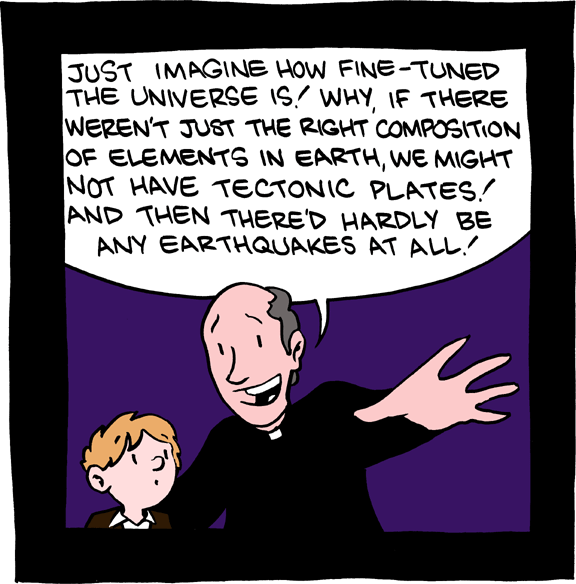
The fine tuning argument revisited

I just listened to last week's Unbelievable podcast on the subject of 'Atheism's New Clothes', featuring a discussion between (academic scientist and Christian) David Glass and (academic philosopher and atheist) James Croft. The discussion was loosely based around the issues raised by Glass in his recent book 'Atheism's new clothes' (sadly not on Kindle yet) which is a response to the books and arguments of the 'new atheists' such as Dawkins, Harris, Hitchens and others (Dennett is usually mentioned in that list, but I don't think he was mentioned in the programme, so I don't know if he is addressed in the book either).

The discussion was supposed to cover all the issues raised in the book, but got bogged down on the issue of the 'fine tuning' of the universe. While Croft did a remarkably good job of shooting down Glass's fine tuning argument and discrediting his flawed use of probabilistic reasoning, he never managed to convince Glass that his take on the fine tuning argument was anything less than water-tight.

The fine tuning argument is summarised in this way on Wikipedia:
"The fine-tuned Universe is the proposition that the conditions that allow life in the Universe can only occur when certain universal fundamental physical constants lie within a very narrow range, so that if any of several fundamental constants were only slightly different, the Universe would be unlikely to be conducive to the establishment and development of matter, astronomical structures, elemental diversity, or life as it is presently understood. The existence and extent of fine-tuning in the Universe is a matter of dispute in the scientific community."
The point is that certain universal constants are built-in to the universe, and without these constants the universe could not sustain life (or, at least, life as we know it), yet there is (so it is claimed) no scientific explanation for why the constants should have those values, and not other values, which would have resulted in a universe incapable of producing life.

The main theistic argument here goes like this: the probability that the constants could have just happened upon the 'correct' values 'by chance' is so vanishingly small that it didn't happen. Those constants must have been selected by an intelligent designer, so therefore there must be a God.

Atheistic counter arguments usually go two ways:

The first is to propose a multiverse type arrangement where there are an infinite number of possible universes, each with a different set of universal constants. These universes may either be in series in infinite time, or in parallel in infinite dimensions. Given enough coordinates in probability space, then it becomes highly likely that somewhere in all this probability there will be a universe with the 'correct' set of universal constants. This way of thinking is favoured by a great many scientists. Of course, this raises the issue of the unseen infinite which I have blogged about before - you can demonstrate that anything can be achieved if you can invoke the explanatory power of an unseen but infinite factor.

The other way is to show that the issue is being looked at the wrong way around. It is not that the universe was fine tuned for our kind of life to emerge, but rather that our kind of life is a product of the kind of universe in which we are. Universes with different sets of constants, should any exist, would produce different emergent types of life, but in every instance it would appear (to the emergent life) that the universe was fine tuned for them to exist.

The show set me considering whether the theist actually has a valid argument. I actually found myself wondering this way:

Suppose the universe was created by a supernatural being who preset the fundamental constants, how did that being decide what the constants should be? Did he (lets stick to convention here and refer to the deity as masculine) try out any other sets of constants in other universes only to discover that they didn't work? How many times did he do this? Even if he only did a 'thought experiment', this is still working through all the possible alternatives until a solution is found. Following this line of reasoning you very quickly end up with the multiverse type arrangement (again with the inherent unseen infinite problem) and God is reduced to the mere mechanism by which the various universes choose their parameters.

Of course, no theist really thinks like this. It is obvious to them that God would just know what the 'correct' parameters should be. But why? For the theist it is not that God had to work out the right parameters, he just knows them. I suppose you could say that the correct parameters for the universe are just there in the mind of God. But how is this thinking any different from the non-theist explanation which thinks that the correct parameters are just built in to the universe and couldn't be otherwise?

In order to demonstrate that the parameters are 'fine tuned' you actually need to be able to demonstrate that the parameters could have been otherwise. As far as I know, no theist has ever done this. As far as we can tell, those parameters are necessary features of our universe and not variables.

Fundamentally, the fine tuning argument for God does not and cannot explain how God came up with the set of fundamental constants that appear to be built into our universe. In other words, it has no explanatory power.

It boils down, basically, to these two options:

  1. The universe has a set of physical constants built into it at the outset. We do not know how these constants were fixed. Or
  2. The universe has a set of physical constants built into it at the outset. They were put there by God. We do not know how these constants were fixed in the mind of God. We do not know how God came to be there.
It looks to me that God doesn't really play a part in the argument. He actually complicates the origin model rather than simplifying it. With God in the picture there are more questions and more unknowns.

Should we use Occam's razor here?

Tuesday, October 09, 2012

Science vs. Religion

I seem to have read and listened to a number of things in the 'Science vs. Religion' debate recently. Are they compatible? Are they complimentary? Are they 'non-overlapping magisteria'?

Reflecting on these questions I have come to the following conclusions:
  • Science and religion must be compatible if and only if we live in a universe with a supernatural component, that is, if there is a God.
  • Science and religion must be incompatible if and only if we live in a universe with no supernatural components, that is, if there is no God.
So, fundamentally, believers in any religion can come around to believing that religion and science are compatible and complimentary - because their world view requires this. However, materialistic 'hard line' atheists will, if they think logically, come to the conclusion that religion and science are incompatible - their worldview requires this.

The answer to the question is therefore: it depends who you are and what you believe.

This is not very useful. To me it looks like we're asking the wrong question here. The question is not are science and religion compatible, the essential question is this: Is there a God? If you can answer that question, then the other question is solved along with it.

Tuesday, January 31, 2012

Science vs Intelligent Design

If you've read my last few posts, you'll know that I got pretty fed up with some Intelligent Design (ID) arguments in a book I've been reading. What I want to discuss here is how ID relates to 'science' in general.

Science is:
"a systematic enterprise that builds and organizes knowledge in the form of testable explanations and predictions about the universe"
(from Wikipedia, paraphrasing Webster's Dictionary)
I would like to tighten that definition up slightly. I would argue (perhaps controversially) that science is a method of testing and explaining how the universe works, in the current moment. Science is fundamentally based on a (usually unstated) presupposition that the way the universe works now is the same as the way it has always worked. "Ye canna change the laws o' physics" as a great man once said. Or, more importantly, the laws of physics don't change. (Whether an agent can change them is a discussion for another day.)

When I do experiments in the lab, I assume that, given the same environmental conditions, the experiment would work in exactly the same way in Beijing as in Edinburgh, and in exactly the same way in 1812 as in 2012. Experience bears this out. When we find discrepancies between experiments carried out in one place and time from results obtained in another place and time, we always find that it is the environmental conditions that are different, not the laws of physics.

Fundamentally, science is the study of the ways things work now, assuming that this will not change in the future and would have been the same in the past.

Science works by proposing a hypothesis (or a range of hypotheses), then carrying out experiments or observations to collect data, which can be used to either confirm or refute the hypothesis.

If a hypothesis has gone through this cycle of experimentation and analysis sufficiently many times, has not been refuted but has been confirmed many times over, then the hypothesis gets upgraded to the rank of 'Theory'. Like the theory of evolution or the theory of gravitation.

In common parlance (particularly in the minds of anti-evolutionists) there is no distinction between a hypothesis and a theory. "It is only a theory" is used to scoff at evolution. The phrase "It is only an experimentally validated hypothesis" should be equivalent, yet this doesn't sound so dismissive, so isn't generally used...

When we come to evolution, we have a problem as far as science goes. In an ideal world we'd simply set up an experiment, wait a couple of hundred thousand years, then examine the data. If we could do that, I have little doubt that the theory of evolution would be validated. Then, evolution would be what I can real science - we'd have proof that evolution is how the world works now.

In the absence of that data (which our descendents will get eventually!) we have to rely on observations rather than experiments. (OK, yes, we can do experiments with bacteria and the like and observe 'micro-evolution' over many hundreds of generations, but we still don't have the timescale to observe 'macro-evolution' whereby those bacteria evolve into non-bacteria.) We can observe the fossil record and we can study the DNA of living (and preserved) animals and make inferences from that. In essence, we can construct an 'experiment' where we take the evidence at the start of the trial (i.e. fossils from a particular early stratum) and compare these with evidence midway through the experiment (i.e. fossils in a more recent stratum) and also with evidence at the end of the experiment (i.e. animals now) and see if the evidence supports or refutes the theory. Much of the evidence examined in this way does indeed support the theory of evolution.

Thus, from a scientific viewpoint, the theory of evolution is validated. Micro-evolution is observed at the micro-scale, and has been shown to have predictive capabilities - predictions have been made regarding bacteria evolution (or adaptation, if you would rather) and these have been demonstrated by experiment.

But evolution only goes so far. It is, by definition, a theory which shows how a population of organisms can change over many thousands of generations. What it can't do is explain how the original population came to be. This is where ID likes to jump in.

The basic point of ID is that because science has no explanation how the original population of organisms came to be, it is plausible to suppose that perhaps an Intelligent Designer started the whole ball rolling. To be honest, I don't have an issue with that line of reasoning, but it is philosophy, not science.

The ID hypothesis has no predictive power. It tells us nothing about how organisms in the present day will react, adapt, evolve, or otherwise change with subsequent generations. Given this, it is not and should not be regarded as science.

ID also pre-supposes the actions of an agent from outside of science effecting change inside science. This basically constitutes a discontinuity in reality, whereby we must (if we accept ID) assume that science changed at the time of the action. In other words, there was a change in the laws of physics. Once again, this is not science, based on the fundamental assumptions of what science is.

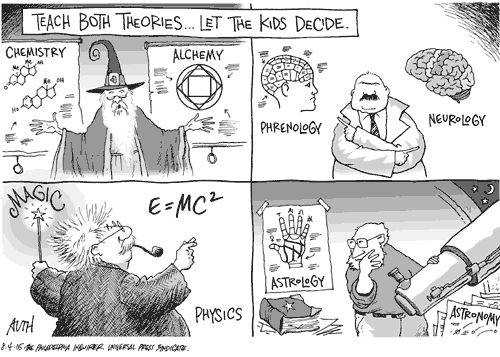
ID should only be discussed in the philosophy class, not the science class.

Sunday, January 22, 2012

Evidence for God: Arguments 17-26 (Science, part 2)

See the previous two posts on this book before reading this one [1,2].

So I've now read 26 chapters (that's just over half the book) of "Evidence for God: 50 Arguments for Faith from the Bible, History, Philosophy, and Science" edited by William Dembski and Mike Licona, and I'm still fed up by all the ID nonsense. At least this now brings us to the end of the Intelligent Design section, or "Science" as the book calls it.

In this chunk of the book are the following chapters:

17. Evolutionary Computation: A perpetual motion machine for design information by Robert J Marks II
This chapter had a point to make, but I have pretty much forgotten it now. I think it was something to do with how 'evolutionary computing' software actually requires an intelligent user, and without that it wouldn't work. But I may just be making that up. It didn't offer any evidence for God anyway.

18. Science, Eugenics an Bioethics by Richard Weikart
An odd title for this chapter, in that it doesn't really talk about science or bioethics. All this sets out to say is that Eugenics is a direct descendent of Darwinism. And by implication Darwinism is bad. Again, no evidence for God.

19. Designed for discovery by Guillermo Gonzalez and Jay W. Richards
This is an odd piece of 'evidence'. The point it makes is that our planet appears to be particularly well placed for observing the universe around us. If we'd been further inside a galaxy, we'd never see out, if we'd been inside a dust cloud, we'd never see out, etc. The case being made is that the planet we live on is 'fine tuned' for observation of the universe and this implies design.

I'm not so sure. Its a very now-centric view of the state of things. Its as if the writers of the chapter are assuming that the whole reason for creation is not just humans, but humans at this point in history. We've learned more about the universe around us in the past 100 years than in the hundred centuries before that. And it won't be too many decades in the future before we are sending probes and ships to explore distant parts of the galaxy, in other words, in not too long our view of the universe won't be limited by our place in the cosmos. The authors are basically saying that God placed us here (within the universe) so that humans (at our stage in development) can investigate the universe. Sorry guys, its not all about us.

For thousands of years, the visible universe has been a mystery to humans and has actually been the source of many, if not most, of the superstitious and pagan beliefs which have rivaled the worship of the 'true God' for most of human history. By placing us here, God promoted astrology and superstition? Not sure this reasoning works.

While it may be an argument for God, I'm not sure its a very compelling one.

20. Intelligent Design: A brief introduction by William A. Dembski
So finally, after six chapters that were devoted to ID and another five or six which were linked to ID, we finally get an 'introduction' to it. This is totally out of place, but compared to the rest is quite refreshing. It says:
"As a theory of biological origins and development, ID's central claim ins that only intelligent causes can adequately explain the complex, information-rich structures of biology and that these causes are empirically detectable."
Which is fair enough. I agree that ID is a valid hypothesis. It may not be a truly scientific hypothesis (see another post I'll write soon), but it is valid. Of course, it explains nothing about how the world works now, it is purely a matter of deistic origin belief, but at present there is no good scientific explanation for the origin of life, so I don't have a problem with people believing it or defending it.

But ID is not a rival to Darwinian evolution - ID is a hypothesis about how things got started, evolution is a theory (i.e. a tested and validated hypothesis) of how things have progressed since then. Evolution theory has no origin explanation, ID has no development explanation.

The main issue I have with ID is that it is a science stopper. Science asks 'How?' ID answers 'No, the question is Who?' - even if it can be demonstrated that there was an original intelligent designer, I still want to ask "How did the designer do it?", ID doesn't seem to even want to ask that question.

21. Intelligent, optimal and Divine design by Richard Spencer
This chapter addresses the criticism of ID which basically says 'if we are designed, why are we not perfect?' and spends a few pages explaining why imperfect things may be desirable. Not an argument for God, rather a defence from attack.

22. Molecuar Biology's New Paradigm: Nanoengineering inside the cell by Bill Wilberforce
Another pointless ID chapter. Its basically the 'life is too complicated to be a product of chance' argument again. Sigh.

23. Panning God: Darwinism's Defective Argument against Bad Design by Jonathan Witt
This seems a rerun of chapter 21. It is a defence of God creating imperfect things. But this time the argument is that God made things imperfect because he wants to have to intervene and 'meddle' with his creation in order to keep it going. The problem this chapter faces is that there is simply no evidence - at all - that God's intervention is necessary to keep the universe running properly. God's intervention is assumed by certain theistic belief structures, but is not demonstrated. If anything, this chapter is evidence against God rather than for him.

24. The role of agency in science by Angus Menuge
This is another defence of ID. Does science assume that the universe works in an entirely materialistic way, or can the involvement of an 'agent' be considered as a hypothesis. Generally no agents are assumed. This chapter argues that by assuming no agents are active, science restricts itself and is therefore not truly 'scientific'.

25. The scientific status of design inferences by Bruce L. Gordon
This chapter aims to blind the non-science literate reader with science. It uses conditional probability as a smokescreen to cover up the fact that it is treading the same ground as the previous chapter.

26. The Vise Strategy: Squeezing the truth out of Darwinists by William A. Dembski
As I've said several times before on this blog, I do not believe there is any such thing as a perfect argument. That is, all arguments have holes in them, and if you pick at the holes the arguments will eventually unravel.

This chapter is not an argument for ID, but rather an unnecessarily detailed description of how to pick holes in the arguments of Darwinists, if you happen to get a chance to cross-examine a Darwinist in the witness box. In other words, its ammunition for ID proponents.

The chapter tells how to get a Darwinist to admit (a) that they don't know everything, (b) that evolution might not fit into a very tight definition of 'science', and that (c) ID might fit into a broad definition of science. That is all it sets out to do, and by doing so, this chapter thinks it proves its case. Maybe it does, but it is very annoying and makes me very angry while it does this. Aaaaargh!

I'm so annoyed that I now feel the need to address ID in a future blog post. So watch this space for details.

In the meantime, finally, the 'Science' section is over. Whew. We move on to 'Jesus' next.

I have to say that in the first 26 chapters of 'evidence' for God, there have only really been about five half-decent arguments for a deistic God, and none completely compelling. I had hoped for more. Is this really the best that Christianity has to offer in its defence?

Sunday, January 15, 2012

Evidence for God: Arguments 8-16 (Science, part 1)

See previous post on this book before reading this one.

I'm now 16 chapters into "Evidence for God: 50 Arguments for Faith from the Bible, History, Philosophy, and Science" edited by William Dembski and Mike Licona, and I'm beginning to regret buying and reading the book. I had thought that the book was going to offer good and well reasoned apologetics arguments for the existence of God. And some of the time it does. But section 2 of the book, which deals with 'Science' and which I am not even halfway through, is getting quite repetitive and is relying heavily on 'Intelligent Design' arguments, which I have little time for. If I'd noticed that Phillip E. Johnson had a chapter in here before I'd bought it, I might not have bothered. But I've spent my money now, and started this blog series, so I might as well continue. Maybe there will be some gems later in the book.

But for now, here are my comments:

Section 2: The Question of Science

8. Creator and sustainer: God's essential role in the universe by Robert Kaita
This chapter has one basic point to make and it makes it several times. The point is this:
Everything humans make eventually breaks and needs fixed or maintained, why should we expect the universe to run without the need for ongoing maintenance?
I'm afraid I don't think this reasoning is very compelling. Why should we expect the universe to be anything like the things we make? Why should something natural behave like something manufactured? Of course, the point being made here is that the 'natural' universe is actually created, but the implication of this reasoning is that if God created everything, he wouldn't be able to do it perfectly, so his ongoing maintenance would be required. Viewed from that perspective, I'm not sure many theists would agree.

9. The pale blue dot revisited by Jay W. Richards and Guillermo Gonzalez
This chapter concerns our place in the universe. It also concerns the paradigm shift that was brought in when Copernicus and others demonstrated that the earth wasn't the centre of the cosmos. The chapter challenges the assumption that the Copernican revolution somehow demoted our place in the universe, in that we're no longer the centre of things, rather it shows that the paradigm shift actually elevated us into the heavens.

All well and good, but this is no argument for or against God in any way. So why is this even in this book? There is definitely an attempt here to muddy the waters of the debate here, to show that things are complicated and not clear cut. But really, this contributes nothing at all to the debate.

10. Oxygen, water and light, Oh My! The toxicity of life's basic necessities by Joe W. Francis
This chapter has a simple point to make. The three things that life relies on: oxygen, water and light, are all - in various ways - toxic. And all living things have very complicated ways of dealing with the toxic effects in order to maintain life. The implied question is 'how could such a complicated system have evolved?' And that is a tricky question, but so is the counter question which is not asked here 'why would an intelligent designer make living systems in this crazy way?' Of course, there is no answer to either of these questions in this book.

11. The origin of life by Walter Bradley
So here it is. The Intelligent Design (ID) defence begins. In summary: life is complicated and couldn't have occurred by chance. To be honest, the previous chapter makes this case better, without actually making this case at all. This one is just padding.

12. What every high school student should know about science by Michael Newton Keas
This is not an argument for God. This is an argument for redefining 'science'. This chapter made me angry. Most of what is said in it is kind of true, but truth with a spin. It redefines science in a way that doesn't include evolution. This chapter, which is longer than most here, annoyed me intensely.

13. Darwin's battleship: Status report on the leaks this ship has sprung by Phillip E. Johnson
Groan. I don't care about the ID vs. Darwinian Evolution debate. One of the things that annoys me the most is the constant over use of the word 'Darwinian'. There's a definite attempt to bias the debate by implying that this is all the fault of only one man.

Darwin made observations, he proposed a hypothesis, then he identified evidence which supported this hypothesis, such that it has now become an established theory. Since Darwin died, so much more evidence has been uncovered which supports the theory, that the theory is not really in question within the realms of science.

Up against this comes 'Intelligent Design', a hypothesis which is not derived by observation or experiment. As a hypothesis it has yet to be adequately refuted. True. But as a theory, it has no predictive power. You can take the theory of evolution, apply it to a certain scenario and make predictions about the outcome. The theory is frequently validated in this way. But what predictive power does ID have? None.

I could rant more, but I can't be bothered.

14. Debunking the Scopes 'Monkey Trial' Stereotype by Edward Sisson
Sigh. Another chapter that is about the ID vs. evolution 'debate' without actually presenting any evidence at all on either side of the debate. This is not an argument for God. This book is not doing what it says on the cover. I am getting really quite annoyed now.

If I'd borrowed the book from someone else or from a library I'd have given up by now, but because I paid the best part of a tenner on this I'm persevering.

15. How Darwinism Dumbs us Down: Evolution and Postmodernism by Nancy Pearcey
Finally, an ID chapter that actually has a point to make! The point is an old one, but a reasonably valid one, which is this:
"If all ideas are products of evolution, and thus not really true but only useful for survival, then evolution itself is not true either - and why should the rest of us pay any attention to it?
Indeed, the theory undercuts itself. For if evolution is true, then it is not true, but only useful."
What the chapter does not do is demonstrate why an evolved theory cannot be true. I suppose this is a kind of 'genetic fallacy'. It may be only an accident that evolution has brought about rationality, but to say that evolution could not result in rationality is false.

16. Limits to evolvability by Ray Bohlin
While I am completely bored by the ID arguments now, I'll acknowledge that this one is also valid. It does appear that selective breeding can only strengthen certain characteristics of an animal so much. Perhaps this is also the case in natural selection?

The problem with this line of reasoning is that selective breeding (i.e. intentional selection) does not involve mutation as one of its steps. Evolution by natural selection does. So the author is not comparing like with like. Its not a perfect argument, but after the nonsense of the last few chapters, it certainly feels like one.

The impression given by all the ID chapters (of which there are still more to come) is not 'here is some evidence for God and/or compelling arguments for God' but rather 'look, there are problems with evolution, look, look, a problem we can't explain... must be God then'. This does not make a compelling case or a good argument.

So nothing really to sum up here, as there's more to come. Assuming I don't smash my Kindle out of frustration at all the ID chapters...

Wednesday, August 24, 2011

Apologetics vs the Scientific Method

I've listened to a lot of apologetics lately. I mean a lot.

It has left me very frustrated. Apologetics is, or should be, a defense of the Christian faith. It really should stem from 1 Peter 3v15:
Always be prepared to give an answer to everyone who asks you to give the reason for the hope that you have. (NIV)
I find it interesting that the word 'reason' features so centrally in that verse. For it is the lack of reason in apologetics which is annoying me.

The Scientific Method

The scientific method is a tried and tested way of using evidence (generally, but not always, in the form of experiments) to confirm or refute hypotheses. The process goes something like this:
  1. Propose hypothesis or range of hypotheses. These may be based on prior knowledge or may be pure speculation.
  2. Carry out experiment or make observation which is able to provide evidence relevant to the hypotheses.
  3. Attempt to falsify the hypotheses using the evidence.
  4. Hypotheses which are refuted (shown to be falsifiable) by the evidence are dismissed.
  5. Hypotheses which are unable to be falsified are considered to be reasonable and are held to be valid until further evidence is found.
Stage 3 is crucial in the scientific method. It is only by attempting to falsify each hypothesis that its worth is ultimately found.

Apologetics also considers evidence and hypotheses. However, the chain of events is somewhat different:

Apologetic Method
  1. Start with a range of hypotheses (i.e. beliefs), generally derived from the bible or church tradition.
  2. When new evidence is presented, formulate a plausible argument which can be used to explain why the evidence is consistent with the prior hypotheses.
  3. If no plausible argument can be found, attempt to discredit or refute the evidence. In extreme cases, simply ignore the evidence.
  4. If none of that works, simply get the argument bogged down in really technical theories so that the audience is bamboozled or loses interest.
  5. Assert that the hypothesis is validated.
There are two basic problems here. The first is that the apologist assumes, from the outset, that the hypotheses are true. The apologist is convinced of that, so in the event of an apparent tension between hypothesis and evidence, it must be the evidence, or our understanding of it, which is at fault. The validity of the hypotheses is never seriously considered.

The second problem falls in the plausible argument. Just because an argument is plausible, doesn't mean that its probable or actually true.

The crux of the issue is that when there is a tension between hypothesis and evidence, science assumes that the hypothesis is flawed, while apologetics assumes that the evidence is flawed.

Of course, the evidence could be flawed. But apologetics will never lead to refinements in the hypotheses, thus will never take us closer to the truth about reality. Science just might.

Monday, September 22, 2008

Being mislead by statistics...

  • In a 1997 study, Beit-Hallahmi and Argyle concluded that out of 700 Nobel Prize winning scientists, only one beleives that there is a God.
  • A 1998 study by Larson and Witham revealed that of those American scientists considered eminent enough by their peers to have been elected to the National Academy of Sciences, 93 percent do not believe in God.
  • In a 2006 British study by Elisabeth Cornwell and Michael Stirrat on the Fellows of the Royal Society, 95 percent of its members do not believe in God.
What does this tell us?

Well, if you listen to the propaganda, it tells us that the more intelligent you are, the less likely to believe in God you are.

Is this right or are we being blinded by skewed statistics?

What kind of person gets to win a Nobel prize? In the vast majority of cases its someone who is utterly devoted to their research and study. Someone with no time to, for example, take a day off every week and go to church. Who get elected the National Academy of Sciences or the Royal Society? People who have made the choice to put science first in their lives.

It is not a measure of intelligence, its a measure of a combination of intelligence, hard work and lifestyle choice. Those who decide to put something else first - be it God, church, family or friends - do not generally get elevated to such positions in science. But this is not necessarily a matter of intelligence, its a matter of choice.

Be careful of statistics. You can prove anything you want with them if the audience isn't thinking!

Friday, September 12, 2008

Creation in the classroom

Weird. Its happening on this side of the pond. [BBC News Link]


I thought the 'teaching creationism as science' debate was a peculiarly American issue. But some leading someone (actually the director of education at the Royal Society; a biologist and reverend) has opened the debate up in the UK.

I have no problem with creationism being taught in the classroom.

But I do have problems with creationism being taught as science and as an alternative explanation to evolution.
  1. It simply is not science. Creationism in its many forms (bearing in mind that Hindu creationism is completely different from Judeo-Christian creationism, etc.) is an explanation of how we got here based on dogma, tradition and (possibly) divine revelation at some point in the past. It may be true. But. It is not science. It is not a testable theory, it is not based on empirical observation. Thus it is completely outwith the remit of science and should not, therefore, be taught in science class.

  2. It also is not an alternative to evolution. The theory of evolution - a description of the process by which one thing can slowly turn into a different thing over a span of many generations - has no explanation of the start point. It describes the change from A to B, from B to C, and so on, but cannot offer any explanation as to the origin of A. Evolution assumes a population of the original things as a starting point. Creationism, on the other hand, only offers an explanation of where the original things came from. Creationism itself does not consider the change from thing A into thing B. One creationist school of thought allows for evolution to work after the initial creative act. Another school of creationist thought says that we were created more or less as we are and there was no evolution.
Sigh. I wish they would teach kids how to think about issues in school, rather than just presenting them with issues as if they were facts. There are actually very few facts that we can be absolutely sure of in the realms of both science and faith.

Saturday, April 07, 2007

Creation Science

Where is the 'science' in Creation Science?

Science is: "The observation, identification, description, experimental investigation, and theoretical explanation of phenomena." (thanks dictionary.com)

'Creation Science' starts with its conclusion ('God did it') and goes round in circles repeating the same conclusion, trying to find evidence to support that statement and trying to find explanations for other phenomena which appear to be consistent with the main conclusion.

At no point does it offer any explanation as to how God may have done it. There is no attempt to propose a mechanism. 'God said "let there be light" and there was' is not science. How did the light come about? What was the initial source? What was the initial power source? Was it instantly at maximum intensity, or did it slowly increase in luminosity? If so, how long until it reached the maximum, if indeed it has yet reached the maximum? If creation science was actually a science there would be speculation about these sorts of questions.