Showing posts with label creation. Show all posts

Wednesday, June 29, 2016

Why "But who made God?" is not a stupid question...

Continuing my thoughts on recently read apologetics, I come to Rev David Robertson's dismissal of the "But who made God?" argument in the book "Why I am not an atheist". He basically (and patronisingly) writes off this argument as childish. Well, he says that it is 'the alleged killer problem' for 'many fourth-form school pupils', implying that any mature thinker will see that this is a red herring. Well, its a long time since I was in fourth-form, and I still think this question has value. I've not heard a good rebuttal to it yet, which I guess is why Robertson has to insult the questioner rather than take the question seriously.

He swiftly jumps to the 'Kalam cosmological argument', which he expresses as:

  1. everything that has a beginning of its existence has a cause of its existence
  2. the universe has a beginning of its existence
  3. therefore the universe has a cause of its existence
"The logic is irrefutable" he says, "The evidence is overwhelming". Hmmm. Not so fast. There are problems with the argument as posed. 

The first (and probably biggest) issue with this line of reasoning is in point number 1. It is missing a very important clause. I think it should be expressed more like this:
  1. everything in our universe of space and time that has a beginning has a cause of its existence in the same universe of space and time...
We might also add an extra clause to the end with the disclaimer: "except quantum events, of course" as those effects apparently occur without causes, even within our universe. Given my modification to point 1, however, point 2 becomes questionable. The universe is not to be found within the universe. Why should the rules that apply within the container also apply to the container itself?

Beyond that, I also have problems with the idea of the universe having a beginning. Certainly it has an origin, in the mathematical sense of the word 'origin', but that is not the same as a beginning. There is nothing before the 'big bang' (or whatever we want to call it) where the supposed initiator could be. There is no time there, there is no space there, there is literally nothing. There is no room for anything to exist, and certainly no non-existent thing could reasonably be said to be an initiating agent. We could redraw the mathematical axes and place the origin elsewhere. The 'origin' doesn't actually have to be at t=0.

I guess most folk imagine the big bang as a single point, a 'singularity' if you will, which then exploded out in three dimensions. Imagine for the moment that the whole three dimensional explosion only occurs in two dimensions. It starts as a point, and explodes in a circle with increasing diameter. Can you picture that? Assuming that the universe doesn't keep on expanding forever, at some point this circle reaches its maximum size, and then perhaps begins to shrink back down on itself, eventually condensing down to a single point again in the so called 'big crunch'. You get a sequence something like this:


Now stack up those circles (viewed almost side on) like this:


What you see (in a very idealised manner) is that the sequence of circles essentially describes the shape of a sphere. Of course, in reality the circles are not discrete, but continuous. So this three dimensional sphere essentially represents four dimensional space-time. 

For us, from our point of view, uncontrollably falling through 4 dimensional space-time on the time axis, there is a clear point of origin, that we imagine is time = 0. But if the observer were not fixed on the time axis like we are (and remember, the apologist is imagining an eternal and timeless agent here), then the selection of our t=0 as the origin is somewhat arbitrary. You could select any point on the surface as origin. Indeed, if the four dimensional existence of the universe is somewhat analogous to a sphere, then what we don't have is a point of origin, rather we have a boundary to the 4D universe. A surface. Not a point in space, but a surface in space-time.

Now stating that the universe has a beginning seems a bit myopic. The universe has a surface. But not everything with a surface has a cause. So the second statement becomes meaningless. And so the conclusion doesn't follow.

Everything that is, is inside the surface of the sphere. There is literally nothing outside of it. Nothing transcends it. It just is. Viewed in 4D, It doesn't change, but change is what happens within it. All cause and effect is inside it. The surface just is.

Now we can conceive an 'eternal' (whatever that means) 4D universe, that doesn't need a cause, because it just is. It is only because we perceive by the arrow of time that we think there is a beginning.

It is only if you are fixated on the time axis, that you need a prime mover. You can call that prime mover 'God' if you want, but he'd just be a blip on the surface.

By the way, this reasoning still holds, I think, if you don't agree with the big crunch idea. In that eventuality, the universe is not a sphere but a parabolic cone. But still a surface...

Sunday, June 19, 2016

But can it explain your destiny?

In the closing chapter of "Why I am not an atheist" (which I have just finished reading), Ravi Zacharias summarises part of his own book "The End of Reason" (which I have not read), and among other things, makes the following claim:
"A world view basically offers answers to four necessary questions - questions that relate to origin, meaning, morality, and hope that assures a destiny. These answers must be correspondingly true and, as a whole, coherent"
He then spends most of the chapter explaining how the Christian worldview succeeds better than an atheist worldview at answering these questions. He never questions the questions. 

Why must a worldview answer all these? Why are they necessary

Surely that biases our opinion in favour of or against certain worldviews by definition, before we've even got to consider them?

Let's start in the middle - Morality. I think I agree with Ravi that our worldview has to give us some guidance as to how to live; what ought we to do? However, I'm not sure this is an 'ought' - we each simply do live according to our worldviews. Anyone who lives in a way apparently contrary to their own worldview, generally does so because they do not fully understand their own worldview, or have not adequately or honestly expressed it. (The first example of this that springs to mind is the huge number of Christians who have sex with people to whom they are not married. They say 'true love waits' is part of their worldview, but actually then mitigate that idea with concepts of a God who'll forgive anything, and so they do it anyway, because they want to. But anyway, I digress...)

So, fundamentally, our morality does flow from our (honestly expressed and fully defined) worldview, because it can't do anything else. But there is no way of judging worldview against worldview here, my morality is fully consistent with my worldview, yours is fully consistent with your worldview. But there are no objective standards outside of either worldview to judge which is better, are there? If your morality is inconsistent with my worldview, does that make my worldview correct? No. It doesn't validate your worldview either.

What about Meaning? Must our worldview offer meaning? The search for a meaning in life is something that only really begins once the questioner has attained a certain amount of leisure and comfort in life. Those who struggle to survive don't need any meaning other than survival, and don't generally have time to think about it anyway. I am convinced that life is better than non-life, so survival itself could be all the meaning that there really is. Does there need to be someone or something greater than me to bestow meaning on my life? I don't think so. We find ourselves in a universe that is far more massive, complicated and interesting than we can possibly comprehend, so if we need to find some meaning for ourselves, it shouldn't be too hard.

There must be an Origin. I agree with that. But does my worldview actually need to have a coherent answer to the question of where we came from before it can be taken seriously as a viable worldview? I'm not sure it does. "I don't know" is a perfectly valid answer to the question of origins. Indeed, I think it is more than that. I think it is "I don't know and neither do you!" You may believe something about the origin of all things, but you certainly can't claim to know in any meaningful way. The more I think about the big questions of life, the more I understand that we really don't know very much about anything with certainty. You can have belief about something. You may even have some philosophical reasoning to justify that belief. You might even have hints of evidence that make a case. But what you can't have is sufficient justifiable certainty to attain knowledge of anything that happened millions or billions of years ago - what happened then is so far beyond our experience horizon that we can only guess, estimate, and hypothesise. So maybe your hypothesis is consistent with some observation of reality, that doesn't prove it, or disprove any other hypothesis, for that matter.

Fair enough, if your worldview offers a story of origins which is inconsistent with reality, then we would be right to challenge and dispute that worldview, but if your worldview offers no answer to the question of origins, it can't be shown to be false in this regard. Its more justifiable to hold to a worldview that doesn't have an explanation of origins than to hold to a worldview that does have an explanation that seems inconsistent with reality. Postulating a pre-existent, transcendent, everlasting, timeless deity as creator actually has far more problems cohering with reality than admitting "I don't know" does. 

Finally, what of Destiny and Hope? Certainly a worldview that "assures" a destiny seems, on the face of it, more appealing than one that doesn't, but what if the future is actually unknown and unknowable? In reality, we don't actually know what will happen in the future. Sure, we can observe trends and make general predictions about large systems, like the weather, for example, but we can't make specific and accurate predictions about that. Will it rain on my garden at exactly midday tomorrow? We can't see that. More importantly, questions like "will I live to see my 50th birthday?" cannot be answered, not in your worldview or in mine. Hope? I hope I live to see 50. Destiny? It isn't written yet. You might think that it is written and pre-planned somewhere, by some God, but you can't know what is going to happen to me, on this side of death or on the other. If there is an 'other' that is. So much of religious worldviews of destiny relies on there being some life post-mortem - your worldview requires it to give hope to those without hope. But is there any evidence for it? No. All you have are (interpretations of) biblical promises that you will never find out the reliability of until after death, if you are able to find out anything after death, that is. My worldview says "I don't know" on the life after death issue too. Does that make your worldview better than mine? Ravi Zacharias thinks it does, but I think his criteria for judging between worldviews are simply begging the question.

Tuesday, September 02, 2014

Is this the sort of a universe that looks like it was designed by a God?

Just listened to last Saturday's Unbelievable show. It was a debate between 'young apologist' Calum Miller and 'humanist community leader' James Croft on the subject of "Is our universe more likely on atheism than theism?". I think, by any standard of marking debates, that Croft won on this occasion as he more than adequately took apart every one of Miller's arguments and offered strong alternative views that Miller was unable to rebut.

I've listened to debates and arguments on this theme before and I have always found them unsatisfying. The problem is generally that both sides seem to have a concept of 'what the universe would look like' if the other person's view was correct, and that concept doesn't match with what they see in reality, so therefore it can't be right. (I have to say that Croft wasn't using this kind of reasoning here, but Miller clearly was.)

The thing is, we have no way of knowing what a universe other than the one we are in would look like. Either this universe was created by a god, or it wasn't. The probability is either 1 or 0.

Suppose, for a moment, that there is no creator god. This universe is therefore the product of naturalistic processes. So the universe as we observe it is what a naturalistic universe looks like. Now at some point in time inside this naturalistic universe, someone conceived the notion of a god. What would the inventor of the god concept make their god like? Well, they'd make that god concept more or less compatible with their concept of the world. In other words, the god concept would be developed to fit with the observed world. In this supposed universe, a god believer asking whether or not the universe looks likely given the existence of a god would almost inevitably come to the conclusion that it is likely - because their god concept meshes so well with their experience and philosophy of the universe. But remember, all this is under the supposition of no god. In this reality, there is no god, but it just seems like there is good reason to believe in one. But it is because god was honed to fit reality, not that god honed reality.

The opposite works too. Suppose, for a moment, that there is a creator god. The universe is the product of design. Yet in this framework, someone devises a system of scientific method which is consistent in its handling of reality without the need for a god concept. Does that mean there is no god? No. The atheistic scientific method is a product of the created order, so of course it is fully consistent with it. And so on.

The problem with this is that, therefore, no observation of the universe can help us to decide either way on the god question. Either hypothesis is equally likely given any observation.

Unless God reveals himself in some obvious way, of course.


And another thing that niggled me about this debate, once again, was somebody with no training in probability trying to use it as part of their argument. Calum Miller is a medical student with an amateur interest in philosophy and apologetics. He clearly doesn't understand probability and inference adequately...

Sunday, March 30, 2014

The God of all possibility?

I've just been listening to a debate between William Lane Craig and Sean Carroll on the Unbelievable podcast. I think Carroll won. Indeed, he wiped the floor with WLC, but anyway.

What I found myself thinking (other than 'what the heck is a Boltzmann brain?') was this:

If there is a creator God who can do anything and everything, and therefore can create any universe, then any conceivable universe (and indeed any inconceivable universe), including a universe where there is absolutely no evidence whatsoever for God, is consistent with the existence of God.

So evidence becomes utterly meaningless in the search for God. It doesn't matter what you observe (or fail to observe) in the universe, anything is consistent with this definition of God. So if you believe in that sort of God, then there is no evidence to dissuade you from your belief...

So given that a great many believers of several religions actually do believe in this sort of God, then there is little point in attempting to reason them out of that belief on the basis of evidence.

Friday, April 12, 2013

On the origin of life...

I've just been listening to last week's Unbelievable podcast addressing the question "How did life begin?" 

While the debate between (atheistic scientist) Adam Rutherford and (theistic evolutionist) Fuz Rana was fairly interesting, I felt that their discussion didn't really address the question posed.

Put simply, you cannot invoke pre-existent life (i.e. God) as an explanation for the origin of life, as that is a contradiction in itself. If a living entity creates another living entity, this is not the origin of anything. It may be the start of a new phase, as it were, but it cannot be the origin.

The philosophical question at the root of the discussion should not have been "How did life begin?" but rather "Did life begin?" - was there ever a time before life, or has life existed from eternity, with no beginning and no end?


Sunday, January 02, 2011

Across the Spectrum: Chapter 4 - The Genesis Debate

This post continues the discussion from this post and this one.

Chapter 4: The Genesis Debate
Position 1: Created in the recent past (young earth)
Position 2: A very old work of art (day-age view)
Position 3: Restoring a destroyed creation (restoration view)
Position 4: Literary theme over literal chronology (literary framework view)

And so we come to the creation vs evolution debate. Except that we don't really. Here we have four different views of creation, some of which are incompatible with both the theory of evolution and the evidence of geology, while others attempt to accommodate modern scientific thinking in some way or another.

Of course, if you were to take the bible as your only source of truth in this matter, it is highly unlikely that you would arrive at any position other than the young earth view. At face value, the first chapter of Genesis looks like it is trying to be an accurate presentation of what actually happened. So positions 2, 3 and 4 are, in some sense, already compromises. And yet the young earth view requires its adherents to deny modern scientific thinking and evidence. What I find fascinating about this is that the young earth creationist view essentially sees the physical world as something that God created directly, without any possible human tinkering, and sees the bible as something God created directly, using fallible humans to write it, and yet they take the evidence of the one that would have been possible to corrupt over the evidence of the one that would be impossible to corrupt or fake. Whichever way you slice it, the geological record contains more than 10,000 years of history.

But what of the other three positions? Well, the day-age view - which is probably the most common view among evangelicals and most other theists for that matter - says that the first chapter of Genesis uses a poetic framework to describe the various ages of creation in terms of days. All well and good and I don't really have much comment to make. Except that if you take this chapter as non-literal, how do you decide which other (apparently literal) bits of the bible are also non-literal?

The Restoration view fascinated me. I actually hadn't come across the 'gap' theory before reading this, but I like it. It is an imaginative and consistent way of reconciling the apparent age of the earth and the geological record with a literal 6 day creation. Basically, the theory is that there is a giant gap (of several hundred million years) between Genesis 1v1 and Genesis 1v2. The 6 day creation described in Genesis 1 is not the first creation, but rather a re-creation of the earth out of the destroyed chaos of the previous creation. Which may also have been made out of the destroyed remains of a previous creation, and so on. Thus, when we dig up dinosaur bones, these are from previous - otherwise completely destroyed - creations. The theory goes that God created something, it went wrong, he destroyed it and started again. Repeat as necessary. Luckily for us, we live in a creation that God has chosen not to destroy completely (see the Flood story) and has, instead, provided a salvation and redemption path for us. Lucky us, unlucky dinosaurs.

The problem with this is that it doesn't quite fit with current scientific knowledge, or with current theology. Science tells us that we (and all other contemporary animals) are decended from the ancient ones. We can track the divergence of genes etc. by comparing our DNA with that recovered from ancient fossils. In other words, there is a continuity path between the allegedly completely destroyed creation and us. It couldn't have been completely destroyed. Genetic material survived, and survived in such a way as to suggest that there was no total destruction which the gap theory needs. Also, we believe God to be the kind of God who seeks to redeem and restore his creation, not destroy it and start again. So all in all, this is a good effort, but ultimately an unsatisfying theory.

Finally, the literary framework position suggests that the author of Genesis 1 had other points to make than what actually happened. Its all about God and not all about creation, it would seem. While, for the most part, I agree with this, it does seem to be dodging the issue a bit.

So, after all this, what do I think? I don't know.

I mean, I really don't know. I am happy to accept scientific thinking on this and accept the scientific picture of how this earth came to be. Science, of course, still can't explain the origin of life, but aside from that the explanations are OK. But where does God fit into this picture? Is he a deist God who starts the whole ball rolling then stands back and watches the whole thing unravel? Is he a tinkering God who continually adjusts and tweaks his creation as it continues? Is he (somewhat controversially) a part of this 'creation' rather than being the creator? I do not know. I have no good evidence to hold to any of these positions, or any of the countless others I haven't presented. But I'm happy to be agnostic on this issue. It doesn't really matter one way or the other, does it?

Surely the present and the future are more important than the distant past?

Friday, September 12, 2008

Creation in the classroom

Weird. Its happening on this side of the pond. [BBC News Link]


I thought the 'teaching creationism as science' debate was a peculiarly American issue. But some leading someone (actually the director of education at the Royal Society; a biologist and reverend) has opened the debate up in the UK.

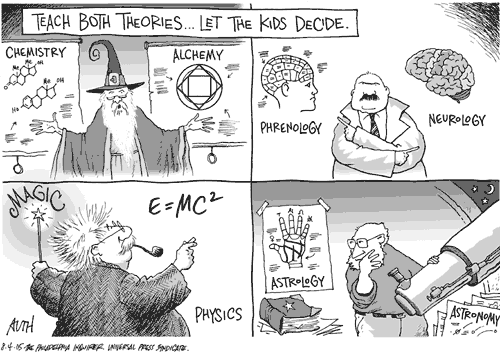
I have no problem with creationism being taught in the classroom.

But I do have problems with creationism being taught as science and as an alternative explanation to evolution.
  1. It simply is not science. Creationism in its many forms (bearing in mind that Hindu creationism is completely different from Judeo-Christian creationism, etc.) is an explanation of how we got here based on dogma, tradition and (possibly) divine revelation at some point in the past. It may be true. But. It is not science. It is not a testable theory, it is not based on empirical observation. Thus it is completely outwith the remit of science and should not, therefore, be taught in science class.

  2. It also is not an alternative to evolution. The theory of evolution - a description of the process by which one thing can slowly turn into a different thing over a span of many generations - has no explanation of the start point. It describes the change from A to B, from B to C, and so on, but cannot offer any explanation as to the origin of A. Evolution assumes a population of the original things as a starting point. Creationism, on the other hand, only offers an explanation of where the original things came from. Creationism itself does not consider the change from thing A into thing B. One creationist school of thought allows for evolution to work after the initial creative act. Another school of creationist thought says that we were created more or less as we are and there was no evolution.
Sigh. I wish they would teach kids how to think about issues in school, rather than just presenting them with issues as if they were facts. There are actually very few facts that we can be absolutely sure of in the realms of both science and faith.

Tuesday, March 18, 2008

Before creation...


Genesis 1v1-5
[1] In the beginning God created the heaven and the earth. [2] And the earth was without form, and void; and darkness upon the face of the deep. And the Spirit of God moved upon the face of the waters. [3] And God said, Let there be light: and there was light. [4] And God saw the light, that [it was] good: and God divided the light from the darkness. [5] And God called the light Day, and the darkness he called Night. And the evening and the morning were the first day. (KJV)
I came back to these verses the other day and something that I had never noticed before jumped out at me. The first day of creation is the creation of light. After that he creates the 'firmament' (day 2), which he calls 'heaven', then he creates 'earth' (day 3). So verse 1 "In the beginning God created the heaven and the earth" is the preface to what follows on the 2nd and 3rd days of creation. Creation starts in verse 3 with the creation of light.

But what about verse 2? Before the creative process starts, there is something; 'the deep', 'the waters' - these seem to pre-exist before creation. The bible does not tell us that God creates these.

So where did they come from?

Saturday, April 07, 2007

Creation Science

Where is the 'science' in Creation Science?

Science is: "The observation, identification, description, experimental investigation, and theoretical explanation of phenomena." (thanks dictionary.com)

'Creation Science' starts with its conclusion ('God did it') and goes round in circles repeating the same conclusion, trying to find evidence to support that statement and trying to find explanations for other phenomena which appear to be consistent with the main conclusion.

At no point does it offer any explanation as to how God may have done it. There is no attempt to propose a mechanism. 'God said "let there be light" and there was' is not science. How did the light come about? What was the initial source? What was the initial power source? Was it instantly at maximum intensity, or did it slowly increase in luminosity? If so, how long until it reached the maximum, if indeed it has yet reached the maximum? If creation science was actually a science there would be speculation about these sorts of questions.


Thursday, January 11, 2007

Now and then

I listened to another atheist podcast on the train this morning. I probably shouldn't do this as it just frustrates me. The 'Infidel Radio' podcast featured an interview with Nicholas Everitt, author of the book 'The Non-Existence of God'. Nicholas Everitt seems like a nice person and made a number of well reasoned arguments in defense of the atheist position. Fair enough.

What annoys me, though, is the unstated assumption that runs through all of the arguments for and against the existence of a deity - that the battleground between theism and non-theism is entirely in the realm of creation or the origins of the universe. Its all 'then', its never 'now'.

The greatest claim, not merely of Christianity but of all theistic positions is that God is. Not that 'God is [something]' (like, perhaps 'God is omniscient') but that God is a reality in the present.

Debates about what happened six thousand years ago or billions of years ago at the time of creation / origin are fine, but they only deal with then, not now. If there is no god now, then what's the point of arguing about then.

So many of the theistic arguements that Nick Everitt knocked down relied on 'God is [something]' reasoning. Thus, if it can be shown to be reasonable that a god cannot be [whatever] then it logically follows that (the specified) god cannot exist. QED.

But none of the arguments even attempted to address the 'God is' issue.

I truly believe that God is. Not because I was raised this way, not because I reasoned my way towards it, but because I have experienced God and cannot find any other reasonable explanation for all the experiences I have had. Sure, some may have been emotional response, some may have been psycological and triggered by the power of suggestion by clever motivational speakers, but not all. Some were due to the real God.

God is - of this I am convinced beyond reasonable doubt.

Of course I still have loads of doubts:
God is omnipotent? Not sure...
God is omnipresent? Could be...
God is the creator? Room for doubt there too...
and so on.
But God is.