Friday, December 11, 2009

Who speaks the truth?

Genesis 2v16-17
And the LORD God commanded the man, "You are free to eat from any tree in the garden; but you must not eat from the tree of the knowledge of good and evil, for when you eat of it you will surely die."
Genesis 3v1-7
Now the serpent was more crafty than any of the wild animals the LORD God had made. He said to the woman, "Did God really say, 'You must not eat from any tree in the garden'?"
The woman said to the serpent, "We may eat fruit from the trees in the garden, but God did say, 'You must not eat fruit from the tree that is in the middle of the garden, and you must not touch it, or you will die.' "
"You will not surely die," the serpent said to the woman. "For God knows that when you eat of it your eyes will be opened, and you will be like God, knowing good and evil."
When the woman saw that the fruit of the tree was good for food and pleasing to the eye, and also desirable for gaining wisdom, she took some and ate it. She also gave some to her husband, who was with her, and he ate it. Then the eyes of both of them were opened, and they realized they were naked; so they sewed fig leaves together and made coverings for themselves.
Genesis 3v22
And the LORD God said, "The man has now become like one of us, knowing good and evil. He must not be allowed to reach out his hand and take also from the tree of life and eat, and live forever."
Hang on. Who speaks the truth in this story, God or the serpent?

The thing the serpent says, "You will not surely die" and "your eyes will be opened, and you will be like God, knowing good and evil", is the thing that comes true. God acknowledges this in verse 22.

The thing God says, "when you eat of it you will surely die", does not happen. It appears (in context) to simply be a ruse to prevent the man and the woman from eating the fruit in the first place.

What gives?

Obviously, I'm happy to believe that this story is a fable, but how to literalist Christians explain this one?

Wednesday, December 09, 2009

Christian Humanist

For no particularly good reason, I've recently been considering how I should label myself when it comes to 'religious' beliefs. I think (for now) I've settled on the phrase:

Christian Humanist

You see, claiming to be merely 'Christian' no longer means anything in our society. If you declare yourself to be a Christian, people either expect you to be:
  1. exactly like them, or
  2. in some way inferior to them, or
  3. a bit weird, but not interesting enough to find out more...
But fundamentally, people often don't think it has anything to do with how you live and has little to do with following the teachings and example of anyone called Christ.

By adding another label to it, particularly one that is often seen as an opposite stance (especially when prefixed with 'secular'), it will hopefully raise questions and provoke conversations.

And, of course, I believe that in many respects, Jesus himself was a humanist:

Luke 14v18-19 (my slight variation on the NIV translation; the original Greek has no mention of 'preaching' to the poor, its an interpolation)
"The Spirit of the Lord is on me,
because he has anointed me
to be good news to the poor.
He has sent me to proclaim freedom for the prisoners
and recovery of sight for the blind,
to release the oppressed,
to proclaim the year of the Lord's favor."
If that's not humanist, I don't know what is...

Saturday, November 07, 2009

In God we Doubt by John Humphrys

It was inevitable that I would get around to reading this book eventually. John Humphrys seems to come at doubt from the opposite side from me - he seems to want to be an atheist, but can't quite get rid of the nagging doubt that "there's more to life than this"...

It is a reasonably interesting book, if - ultimately - pointless. You see, the book begins and ends with the point I made above. And passes through that same point several times. It doesn't actually go anywhere. Along the way we get to see Humphrys's reasons for his disillusionment with the Anglican church - yes, this is a very Anglican book - and his frustrations with some of the more militant atheists (Richard Dawkins and Christopher Hitchens are mentioned more times than are probably necessary, although few other atheists are named), but there's no sense that Humphrys was in any way changed by the research he did or the people he spoke to.

In the end he semi-concludes that religion is probably a good thing, even if there probably is no god. Although maybe there is. Frustrating.

So I don't exactly recommend this book. Unless you really do have nothing better to do with your time. There are far more interesting books regarding the theist/atheist debate out there.

Thursday, November 05, 2009

Fundamentals of... what?

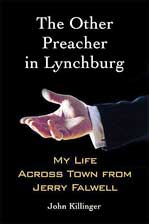
I listened to an interesting podcast interview with John Killinger yesterday. The interview was largely focused on his recent book "The Other Preacher in Lynchburg: My life across town from Jerry Falwell" and gave a few interesting insights into the life and ministry of Jerry Falwell.

But a few things John Killinger said about 'fundamentalists' in general stood out.

His first assertion was that 'fundamentalism' (in Christianity at least) didn't really exist before the early 20th century, and it was primarily a reaction against Darwinism. So when people talk about getting back to the fundamentals of the faith, they don't mean getting back to anything that was actually believed or lived out by Christians for the majority of history since the time of Christ.

And from a few things he said, I realised that what people generally mean by the 'fundamentals of the faith' is a set of (allegedly fundamental) beliefs. Its all to do with what you believe, and nothing to do with what you actually do. Nobody talks about the fundamentals of practice - the fundamental things a Christian is supposed to do (you know, the heal the sick, feed the hungy, love your enemy type stuff).

Jesus didn't go around saying "believe in me" to people, he said "follow me" - this invoves doing stuff...

I don't think faith is just about belief. I'm with James on this one:
"What good is it, my brothers, if a man claims to have faith but has no deeds? Can such faith save him? Suppose a brother or sister is without clothes and daily food. If one of you says to him, "Go, I wish you well; keep warm and well fed," but does nothing about his physical needs, what good is it? In the same way, faith by itself, if it is not accompanied by action, is dead." (James 2:14-17)

Thursday, October 29, 2009

Key to the kingdom...?

I've been a Christian for 21 years. Exactly.

If you want the precise details it was about 8:30 in the evening, on Saturday 29th October 1988, somewhere about here:
I was on the Glasgow to Edinburgh train and hadn't quite reached Falkirk... So now you know.

Saturday, October 03, 2009

Speaking the truth in love...

Inspired by last week's sermon from The Meeting House... It was a good one, why not download it?

Ephesians 4v14-16
[14] Then we will no longer be infants, tossed back and forth by the waves, and blown here and there by every wind of teaching and by the cunning and craftiness of men in their deceitful scheming. [15] Instead, speaking the truth in love, we will in all things grow up into him who is the Head, that is, Christ. [16] From him the whole body, joined and held together by every supporting ligament, grows and builds itself up in love, as each part does its work.
[Back in June I commented on the verses immediately preceding these. I'm not that slow a reader to just be getting to this now...]

What does it mean to "speak the truth in love"?

So often I've come across folk who're prepared to use that verse as a justification for pointing out the errors of others: "Brother I love you, so its my place to point out that your behaviour in this area of life is not good, and you need to change your ways..."

That's speaking the truth in love, isn't it?

But how does that fit with Jesus's words in Matthew 7v3-5?
[3] "Why do you look at the speck of sawdust in your brother's eye and pay no attention to the plank in your own eye? [4] How can you say to your brother, 'Let me take the speck out of your eye,' when all the time there is a plank in your own eye? [5] You hypocrite, first take the plank out of your own eye, and then you will see clearly to remove the speck from your brother's eye."
Here, speaking the truth would involve the admission that "I've got a whopping big log in my eye". In other words, my problems are bigger than yours, I can't claim the moral high ground. And the 'in love' bit only comes into it because I'll only speak the truth about me in the context of a love relationship where I know I won't get abused because of it...

Also, how about James 5v16?
Therefore confess your sins to each other and pray for each other so that you may be healed. The prayer of a righteous man is powerful and effective.
That's more speaking of truth in love. Wow. Does anybody do this in church these days? Not confessing your sins to the priest in the confessional, but to each other.

That's
speaking the truth, in love.

Friday, October 02, 2009

Foundations

Following a challenge by a friend of mine, I've been listening to some sermons by an American theologian whose position is considerably more conservative than mine. On the whole, I've found it to be a reasonably interesting experience and there's surprisingly little I'd disagree with the guy on.

But one thing struck me while listening to the sermons. He is very hard-line on the unchanging nature of God and the infallibility of the bible. Fair enough, many Christians are. You can find my thoughts on the infallibility of the bible in several of my previous blog postings. And while I've previously doubted the unchanging nature of God, I remain reasonably agnostic on the issue.

But the thing that struck me about this guy was not that he stuck to these 'foundations', but rather his reason for sticking to them. He didn't seem to justify them from the bible itself, or from some other first principles. No, his main reason for holding to these two foundations seems to be along the lines of "this must be true, or else we couldn't be certain of anything...".

So its not that he has good reasons for holding to those things, its just that the worldview he has chosen requires them to be true. His whole theology would fall apart if they weren't true. For him they appear to be unquestioned foundations. And he daren't question them, because if they turn out not to be solid foundations, then the world becomes a much more complicated place and everything becomes uncertain.

I can't go along with this line of reasoning. The universe is an uncertain and complicated place.

But what do you lot think?

Saturday, September 05, 2009

WWJD(IHHK)?

WWJD? Sometimes it seems so clear cut. Someone is in need of help. WWJD? Help, of course. Here is a poor person in need of a friend. WWJD? Well, be a friend, of course. And so on.

But being a friend to the poor, the needy, the downtrodden is (relatively speaking) easy for a single person to do. But what about when you have kids? What if there's a family at your kids' school who really need some light in their lives?

WWJD? Well, we know.

But What Would Jesus Do If He Had Kids?

In the specific situation I'm thinking about, befriending the family in question might have serious consequences for my kids. The very least of which would be head lice. The very worst of which - assuming even some of the rumours about the father are true - don't even bear thinking about.

WWJDIHHK?

I really don't know. Should we love the oppressed at the expense of our own family?

Sunday, August 09, 2009

1 John 3v9

"No one who is born of God will continue to sin, because God's seed remains in him; he cannot go on sinning, because he has been born of God."
Cannot?

Does this verse not fly in the face of almost all Christian experience?

I know I should probably go and read a few commentaries here, but I don't have any for the letters of John, so I'll just ask you lot. How do people reconcile this verse? Everyone sins, right? So nobody is 'born of God'...

Confused.

Sunday, June 14, 2009

Quote / Misquote

Ephesians 4v7-13
But to each one of us grace has been given as Christ apportioned it. This is why it says:
"When he ascended on high, he led captives in his train and gave gifts to men."
(What does "he ascended" mean except that he also descended to the lower, earthly regions? He who descended is the very one who ascended higher than all the heavens, in order to fill the whole universe.) It was he who gave some to be apostles, some to be prophets, some to be evangelists, and some to be pastors and teachers, to prepare God's people for works of service, so that the body of Christ may be built up until we all reach unity in the faith and in the knowledge of the Son of God and become mature, attaining to the whole measure of the fullness of Christ.
We looked at this passage in housegroup this week. I've read it before, but don't think I'd ever checked back to the OT passage that Paul quotes here. This time I did and found it says this:

Psalm 68v18
When you ascended on high, you led captives in your train; you received gifts from men, even from the rebellious—that you, O LORD God, might dwell there.
Now hang on! Paul says that God gave gifts to men, but the original says that God received gifts from men. This is really bad. If I heard a preacher making such a mistake today I wouldn't rate them very highly! Paul has a point to make about God giving gifts, but he can't find an OT verse to support his claim, so he misquotes one... entirely changing the sense of the verse.

Oh, and there is nothing in the original passage about descending either. The image is of the triumph of a conquering king receiving tribute from his enemies.

Anyone have any thoughts on this? I'm bamboozled.