Showing posts with label fundamentalists. Show all posts

Sunday, November 14, 2010

Portofino

Portofino is a seaside resort in northern Italy, and is the setting for a novel by Frank Schaeffer - the son of the well known Presbyterian missionary, writer and preacher Francis Schaeffer. The book claims to be fiction, but apparently (if you read Frank Schaeffer's autobiography 'Crazy for God') it is largely based on Frank's real life experiences as a child.

The family presented in the book are fairly extreme, fundamentalist, Presbyterian types. The book is from the point of view of the youngest son - Calvin - who isn't quite as extreme in his views as the rest of his family. (This very much mirrors Frank Schaeffer's own life, as he rejected the fundamentalism of his upbringing and is now part of an Orthodox church).

As someone who grew up in a 'Conservative Evangelical Presbyterian' church, an awful lot of this book is frighteningly familiar. The characters are slightly (but only slightly!) exaggerated versions of people I grew up around. All the attitudes and opinions are real.

And the book shows just how ridiculous and unrealistic some of the attitudes and opinions are, in the context of the real world. The book also shows the hypocrisy of the main family and the tensions within the family, all of which rung very true.

If you want a (not very flattering) look into the minds of Conservative Evangelicals in the 60s (and not much had changed by the 70s, when I came along) then this is the book for you. The opinions regarding the 'lost', trying to out-pray each other to show who was more pious, praying extended graces over meals in public places as 'witness', all this was frighteningly accurate. I particularly loved the ongoing joke about the Presbyterian church the family were part of, which kept on splitting into factions, and so the PCUSA became the PCCUSA and later the PCCCUSA.

Anyway, if your upbringing was anything like mine, you'll find this an entertaining, if cringeworthy, read.

Wednesday, July 07, 2010

Post-evangelical?

I've just read 'The Post Evangelical' by Dave Tomlinson. I read it on holiday in the space of 24 hours, its a short book.

Its a good book, on the whole. Like many of the people on the Amazon reviews page, and elsewhere online, I read it with a sense of relief - there are other people out there like me. And yet, it still leaves a slightly odd aftertaste and a slightly uncomfortable feeling that I can't quite put my finger on.

So what is a 'post evangelical' you might be wondering?

Well, the book is making a case for a third flavour of modern Christianity. Like the author, I was brought up in an 'Evangelical' church where it was believed that there were only really two types of congregation - 'evangelical' or 'liberal'. If you weren't evangelical, you were liberal by default. Evangelicals are the ones who take the bible literally as the Word of God, while liberals are the ones who critically question (i.e. doubt or disbelieve) almost everything in there...

The book makes the case that there are a number of people (the book is based on a number of interviews, we are told) who don't really fit into evangelical churches, who question beliefs and doubt bible stories, but still hold to the 'evangel' - the gospel. These people are not, and do not want to be liberals, but they're not really evangelicals either - they just don't hold the same certainties about the bible or God as most evangelicals do. There is a lot more uncertainty and mystery in post-evangelicalism than there is in evangelical churches.

So there are many good points, well made in this book. And then you realise that the book was written 15 years ago and surely the post evangelical 'movement' it was describing the start of should have come to something by now...? Where are the post evangelical churches? Have I missed it, or did the movement just never happen?

While the main emphases of the book are good and well presented, it does occasionally stray off the path - it goes too far into its discussion of aspects of 'post modernism' and sociology at times, and sometimes there is no clear reason why the author holds so close to some evangelical beliefs whilst drifting so far from others. For example (and, to me this was the most clanging mis-step in the book) early on the author questions the place of marriage for the Christian - basically asking the question 'is it OK for Christians to live together before / instead of marriage?' - and coming to the out-of-place conclusion that the actual marriage ceremony is not that important to the post evangelical! And this without much justification. And then a few paragraphs further on he asserts that the post evangelical will agree with all of the Apostles Creed. Dunno about most people who the book resonates with, but I get those the other way around.

It was a good book. Not a great one. It'll only take you a couple of hours to read and it does contain some gems. Definitely recommended, despite the flaws.

Monday, April 12, 2010

'What the Bible really teaches: A challenge for Fundamentalists' by Keith Ward

I can't remember how this book ended up on my Amazon wishlist, but somehow it did and I bought it.

To be honest, I found it a bit of a struggle to read, but not for good reasons.

The basic purpose of the book is to demonstrate that the range of "Bible based" beliefs of fundamentalists are not 'what the Bible really teaches'... This purpose, the book sort of manages. But it fails in other regards.

The main problems with the book are:
  • the author occasionally uses a really clunky writing style
  • he repeats himself far too much
  • that the word 'sublated' is used several times per page (if I never read that word again, it'll be too soon)
  • and that the author attempts to give a 'true' picture of what the Bible really teaches while demonstrating that the fundamentalist view is false...
You see, the author does a pretty good job of demonstrating that several views of fundamentalists are flawed. And if he'd stuck to that, the book would have worked (although it would have been very negative). But instead he proposes an alternative belief/interpretation for each view and ends up proposing something that is equally as flawed as the fundamentalist view he has just trashed.

I think the main problem is that he tries to maintain that 'the Bible' has a single, unified message. Of course, a simple reading of it will show that this is not the case. There are disagreements and inconsistencies within the bible. For example, does the follower of Jesus have to follow the Torah law? - absolutely yes, if you go by the teaching of Jesus in Matthew's gospel, absolutely not, if you go by some of the letters of Paul. The author can't bring himself to admit that it is possible that Matthew had a biased opinion which colours his gospel, so he ends up explaining how Paul's writings 'sublate' the teaching of Jesus. Hang on. He's saying that the incarnated Son of God appears and teaches a simple message, which is then overturned and superceded by the teachings of a mere man less than a generation later and before the original teachings had even been written down? Seems a bit unlikely.

Me, I think its more likely that the Son of God preached a message that would stand for all time, and both Matthew and Paul interpreted it through their own preconception-filters, and its this interpretation which they then wrote down. Of course, that doesn't allow the Bible to be infallible, but that's probably a blog post for another time.

But its not all bad. I really quite liked the discussion of belief in the 'Second Coming' (to be discussed in a future blog post) and the bits about Jesus's death as atonement or otherwise. But the take on 'Salvation' was bamboozling and inconsistent, as was the discussion of morality.

So I can't recommend this to anyone. But there was some interesting stuff in there. You might like it.

Thursday, November 05, 2009

Fundamentals of... what?

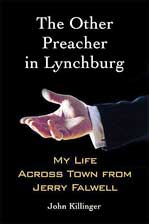
I listened to an interesting podcast interview with John Killinger yesterday. The interview was largely focused on his recent book "The Other Preacher in Lynchburg: My life across town from Jerry Falwell" and gave a few interesting insights into the life and ministry of Jerry Falwell.

But a few things John Killinger said about 'fundamentalists' in general stood out.

His first assertion was that 'fundamentalism' (in Christianity at least) didn't really exist before the early 20th century, and it was primarily a reaction against Darwinism. So when people talk about getting back to the fundamentals of the faith, they don't mean getting back to anything that was actually believed or lived out by Christians for the majority of history since the time of Christ.

And from a few things he said, I realised that what people generally mean by the 'fundamentals of the faith' is a set of (allegedly fundamental) beliefs. Its all to do with what you believe, and nothing to do with what you actually do. Nobody talks about the fundamentals of practice - the fundamental things a Christian is supposed to do (you know, the heal the sick, feed the hungy, love your enemy type stuff).

Jesus didn't go around saying "believe in me" to people, he said "follow me" - this invoves doing stuff...

I don't think faith is just about belief. I'm with James on this one:
"What good is it, my brothers, if a man claims to have faith but has no deeds? Can such faith save him? Suppose a brother or sister is without clothes and daily food. If one of you says to him, "Go, I wish you well; keep warm and well fed," but does nothing about his physical needs, what good is it? In the same way, faith by itself, if it is not accompanied by action, is dead." (James 2:14-17)

Monday, September 29, 2008

How to Get Rich as a Televangelist or Faith Healer

I heard the author of this book interviewed on the Infidel Guy show a couple of months back. It was reasonably interesting, so I thought I'd buy and read the book.

Its a short book. You could probably read it in a single sitting if you had a few spare hours. It is also reasonably interesting and informative, even if it does have a few annoying characteristics, which I'll get to in a mo.

However, its not a particularly uplifting or affirming read (as you might have guessed) and is downright depressing at several points.

The author of the book is clearly a disgruntled guy who got taken in by some religious con artist a couple of decades ago. He presents himself as a once gullible, evangelical Christian, but doesn't really say what his beliefs are now, which is a big hindrance to fully understanding where the book is coming from.

Even having finished the book, I'm not sure if the author's main point is:
  1. "All successful Christian leaders are charlatans and just out to make money out of your gullibility; there is no God really...", or
  2. "These are the techniques the bad guys use to lead good Christians astray, watch out for them and keep following the good guys..."
I suspect the author's intent is actually somewhere between the two, while this is not stated in the book, I suspect the author was raised in a fairly fundamentalist church, had a bad experience or two and now is an agnostic or an atheist.

So anyway, the book is presented as a 'how to' guide, but is really more of a guide through some of the more colourful pseudo-Christian con-men (and women) of the 20th and early 21st centuries.

The book presents all of these characters as being corrupt and charlatans from the outset, whereas in some cases I have sometimes wondered whether some of these people started out with the right intentions and gave in to the temptations that their positions afforded, ending up being out for their own gain, but possibly starting off with a gospel agenda. I mean, some are clearly con-artists at the start, but maybe not all of them. Or maybe I'm being too naive.

I recently blogged about the Lakeland 'outpouring' and Todd Bentley. Given that this book was written last year, it never mentions Todd, but it is amazing just how much of a fit there is between the 'instructions' given in the book and the things that seem to have happened at Lakeland. A few good Christian people have told me good things about their experiences with the Lakeland thing, but I must admit that I am still agnostic on this one. I'm considering 'revisiting' Lakeland in another post soon...

So, you're probably wondering how to go about getting rich as a televangelist or faith healer. Well, there's a few easy steps to follow. These are:
  1. Get some form of credentials, but not from a prestigious institution. Some small bible college that nobody has ever heard of is good. There are several online ones that will ordain you for cash. These are fine.
  2. Present yourself as the mediator between God and man. Yes, the bible presents Jesus as the only mediator, but you need to present yourself as the mediator between the people and Jesus, who then mediates between you and God.
  3. Build your mailing list. It is reasonably easy to persuade people to part with $1 or other small amounts of cash, but to make money this way you need a big mailing list.
  4. Target Christians from specific denominations only. You'll get nowhere going for folk from the big denominations like the Anglicans and the Presbyterians, but rather target folk from the smaller denominations with names like "Full Spirit Assemblies of the Family of God"...
  5. Preach the 'prosperity gospel' and look the part - your 'flock' will expect you to have a big car, a big house, expensive suits, expensive jewelry, etc.
  6. If you're balding, wear a wig. Its all about image.
  7. Learn some bible verses and quote them often, but be careful which ones you use.
  8. Avoid actually preaching about what the bible says about Jesus - I mean, he doesn't exactly promote the prosperity gospel, does he? He loved the poor and saw riches as a hindrance to getting to heaven. What you need is 'Diet Jesus'...
  9. Demonise your opponents. Anyone who says anything against you must be in the control of Satan.
  10. Speak in tongues. Any random string of syllables will do.
  11. Be careful who you attempt to 'heal'. You're not gong to be able to heal amputees. Bring people onto the stage in wheelchairs, but only those who are capable of walking. Only heal non-visible illnesses, cancer is good, etc.
There is other advice, but you get the idea.

The thing is, you come away from reading this book wondering if there are any genuine or honorable 'televangelists' out there. Are any of them serving the gospel or are they all con men?

There probably is an answer to that, but not in this book.

So, all in all, this is an eye-opening read but is probably not recommended for anyone as it will make Christians less sure of their own church leaders, and will give non-Christians a skewed view of honest preachers and genuine healers (if such people do exist).

Friday, September 12, 2008

Creation in the classroom

Weird. Its happening on this side of the pond. [BBC News Link]


I thought the 'teaching creationism as science' debate was a peculiarly American issue. But some leading someone (actually the director of education at the Royal Society; a biologist and reverend) has opened the debate up in the UK.

I have no problem with creationism being taught in the classroom.

But I do have problems with creationism being taught as science and as an alternative explanation to evolution.
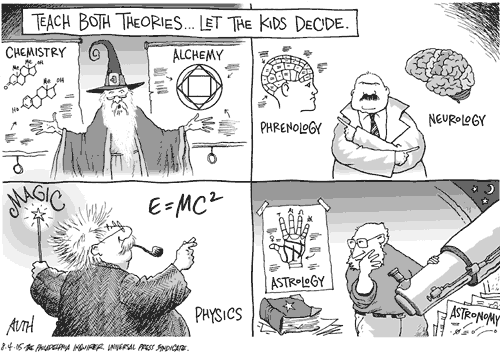
  1. It simply is not science. Creationism in its many forms (bearing in mind that Hindu creationism is completely different from Judeo-Christian creationism, etc.) is an explanation of how we got here based on dogma, tradition and (possibly) divine revelation at some point in the past. It may be true. But. It is not science. It is not a testable theory, it is not based on empirical observation. Thus it is completely outwith the remit of science and should not, therefore, be taught in science class.

  2. It also is not an alternative to evolution. The theory of evolution - a description of the process by which one thing can slowly turn into a different thing over a span of many generations - has no explanation of the start point. It describes the change from A to B, from B to C, and so on, but cannot offer any explanation as to the origin of A. Evolution assumes a population of the original things as a starting point. Creationism, on the other hand, only offers an explanation of where the original things came from. Creationism itself does not consider the change from thing A into thing B. One creationist school of thought allows for evolution to work after the initial creative act. Another school of creationist thought says that we were created more or less as we are and there was no evolution.
Sigh. I wish they would teach kids how to think about issues in school, rather than just presenting them with issues as if they were facts. There are actually very few facts that we can be absolutely sure of in the realms of both science and faith.

Wednesday, February 20, 2008

I worry about fundamentalists

I watched a documentary on BBC 2 last Wednesday - "The End of the World Bus Tour" - part of the 'Wonderland' documentary series. The blurb said:

"The eclectic, observational documentary series continues this week with The End Of The World Bus Tour.

Most package-holiday tourists are seeking sun, sex or adventure, but the customers in Sharon Stolebarger’s charge are looking for something rather different.

Sharon is the tour rep on a special 10-day holiday for people who believe the Apocalypse is only a few years away. Her customers are off to Israel to take a last-chance look at the “valley of Armageddon” – before it’s awash with the blood of unbelievers – and to get baptised in the very waters that Jesus once walked on. They even get the chance to spend a day helping out at an Israeli military base – the highlight of the holiday for many of the tourists.

As the bus winds its way through the Holy Land, the tourists talk about their vision of Doomsday and reveal troubled pasts that seem to have led some of them to take refuge in such extreme religious beliefs. But as soon as film-maker David Clews gets to know them better, they decide they want to save his endangered soul and threaten him with an eternity of suffering."
So basically the documentary followed a group of (mostly, but not exclusively, American) Christian fundamentalists as they visited the 'holy land', not to follow in the steps of Jesus or anything like that, but to see where the final battle between God and man will take place. All these people passionately believe that they are living in the 'end times' and that Armageddon will happen sometime soon, 'within the next ten years'...

Two things struck me the most about these people.
  1. The think that the slaughter of all the 'armies of the world' will be a glorious thing. There definitely was a suggestion of relish in the voices of those who spoke of it. They don't want to save all the lost before the end comes, they want the end to come so that the sinners can be slaughtered.
  2. They sing the same worship songs that are sung in the church I go to. We are literally singing from the same hymn sheet. I don't want in any way to be associated with these people, and yet to the outside observer we're on the same team.
How can these people hear the non-violence message of Jesus (e.g. the 'turn the other cheek' bit) and sing songs of God's love and also relish the slaughter of thousands. God doesn't want anyone to perish (2 Peter 3v9) so how can his alleged followers long for it? This is pure doublethink.

I really do worry about poeple like these. Are there folk like that in my church?