Showing posts with label apostles. Show all posts

Saturday, February 03, 2018

The Resurrection and the 'Minimal Facts' approach.

James, brother of someone.
I've recently read "The Case for the Resurrection of Jesus" by Gary Habermas and Mike Licona, and discussed that book on a weekly basis with one or two Christians for a few weeks in November last year. The case presented in this book seems to be the best case that Evangelical Christianity has that the resurrection of Jesus was a true, historical event.

I've touched on this subject before (in these blog posts from 2012: 1, 2, 3, & 4), but that was over 5 years ago and I have read much more on the subject since, so it may be worth revisiting my thoughts on the subject now.

The case rests squarely on the shoulders of four or five 'minimal facts', and the discussion goes from there. I guess we need to start by asking what 'facts' are. Dictionary.com defines fact as:
  1. something that actually exists; reality; truth
  2. something known to exist or to have happened
  3. a truth known by actual experience or observation
  4. something said to be true or supposed to have happened
This doesn't help us much as the final definition of 'fact' includes the possibility that a fact may, in fact, not be true. To claim that something is a fact, is not necessarily to demonstrate that it is true!

The astounding thing about the 'minimal facts' presented in this argument, is that Habermas and Licona do not, at any point in this book, set out to prove that the minimal facts are, in fact, true facts. There are layers of reasoning and explanation and 'proof' for various things in this book, but they are all based on the assumption that the four (or five) minimal facts are true.

The argument goes like this, if these four (or five) facts are true, then the resurrection appears to be more probable than the alternatives. For the most part I agree with this argument. Where it falls down, of course, are the four (or five) alleged facts.

So what are these 'facts'? Well they are:
  1. Jesus died by crucifixion
  2. After this, his disciples believed that they saw him alive again
  3. Paul, the persecutor of the church, became a Christian following what he believed to be an encounter with the risen Christ
  4. James, the skeptic brother of Jesus, became a Christian following what he believed to be an encounter with the risen Christ
  5. Jesus's tomb was found empty
The last of these is put out of sequence, because this is the least attested 'fact' in there and is not relied upon in the book. Habermas & Licona's case is made using the first four 'facts' and the fifth is simply used as the icing on the cake, as it were.

For Habermas & Licona, these are established as 'facts' because the majority of biblical scholars hold them to be true, irrespective of their personal beliefs. That is, even skeptical and non-believing scholars hold these to be true.

I think that there is a huge selection bias in this. What sort of person becomes a biblical scholar? Only someone raised in a Christian context, who probably began their studies as some flavour of believer. Even if they then abandoned their faith, they most likely started their study of the bible with presumptions that some (at least) of the biblical stories were true and historical.

If you took a thousand Islamic scholars and asked them if Mohammed encountered the angel Gabriel in a cave, I'll bet that the majority think this is historical fact. Just because a majority believe something does not establish it as fact. 

I'll bet if you took all the religious leaders in Judea in 40AD and asked them if Jesus was the son of God, the overwhelming majority would say no he was not. Would that establish the truth? No. So why should a headcount establish historical truth here?

The 'minimal facts' argument is only a valid argument if you can defend the four (or five) facts without an appeal to authority or majority. Habermas and Licona do not do this, so their case is still unproven.

So why don't I believe these supposed facts? Lets take them one by one, starting with the last.

The Empty Tomb

What evidence have we for the empty tomb? Only the gospel accounts, or later texts which are derivative of them. So the empty tomb can only be considered a historical fact if we can accept that the gospels contain historical information. Habermas & Licona don't even attempt to prove that the gospels contain historical information. They simply assume it, noting that some biblical details can be verified from secular historical sources. Then they go further in suggesting that if there is a historical claim in any book in the bible that cannot be verified from secular sources, we should give the bible the benefit of the doubt and take it on trust that the biblical facts are true. Huh? What kind of historian does this? "The Bible" is a collection of 66 books by multiple authors, many of whom are unknown to us. Even if some of those authors included reliable historical facts in their books, this tells us nothing about the reliability of the authors of the other books. If the book of 2 Kings contains historical information, does this imply that the book of Jonah does? Of course not.

So do the gospels contain historical information? Well, certainly there are characters in the gospels who are known to secular history - two Herods, Pilate, and John the Baptist, but that's about it. Aside from the census, recorded only in Luke, there are no historical events in the gospels that can be confirmed using independent sources. Not even the death of Jesus, as we'll see below. So we really have no way of knowing if most of the stories on the gospels have any connection to real historical events.

However, the main problem with the empty tomb is that we would never have heard of it had it not been part of the larger story of the death and resurrection of Jesus. It is not independent data. Given that, we can't use this as evidence for the 'historical' resurrection of Jesus as it only exists as part of a story that makes this claim. Trying to argue from the empty tomb to the resurrection is like trying to prove that the exhaust ports on the Death Star were badly designed, using the evidence that Luke Skywalker destroyed the Death Star by firing a torpedo into it. The two 'facts' are part of the same story and you can't have one without the other. If one of them is questionable, the other must also be questionable.

There is also no case to be made for multiple attestation within the gospels here, as a couple of centuries of textual criticism have convincingly demonstrated that the account of the crucifixion in Mark is dependent on the Psalms, the accounts in Matthew and Luke are dependent on Mark, and that the account in John is probably dependent on Luke. The crucifixion looks like a literary construct, and the empty tomb forms part of the same (fictive?) story.

It doesn't matter if a whole heap of biblical scholars believe this to be history, I'm not convinced.

The death of Jesus by crucifixion

Let's jump to the first (and least contested) of the minimal facts next; Jesus death by crucifixion. Pretty much everyone accepts this as true, right? Indeed, but it suffers from the same problems as the empty tomb - there are no stories of the death of Jesus that don't go on to involve the resurrection. All accounts of the death of Jesus are followed by major miracle claims, and claims that Jesus is or was divine. You really can't separate one from the other. If the stories of Jesus dying on the cross are taken as facts written by reliable historians, then the resurrection is also a fact written by a reliable historian! You can't assume one to be a fact of history, and the other to be questionable. If the resurrection is questionable, then Jesus death by crucifixion is just as questionable. If one is fact, the other should be assumed to be fact. We have no independent data about one that does not also concern the other!

All secular references to the death of Jesus are entirely dependent on the stories told by believing Christians. And as far as we can tell, the earliest believers believed that he was raised just as much as they believed that he died. If they were wrong about one, they could equally be wrong about the other. The observation that one story is miraculous and the other non-miraculous is irrelevant here. In a story containing many unbelievable and impossible events, we can't simply take all the mundane and possible events as probably true.

To establish that Jesus died by crucifixion we would need an account of his life and death that did not feature miracles and did not feature any resurrection claims. As far as I know, no such evidence exists. Literally everything we know about the life and death of Jesus comes to us from the accounts of those who fundamentally believed that he had triumphed over death and had risen. If they were wrong about that, what else were they wrong about?

The conversion of James

I'm even less convinced by this claim than by the empty tomb, even though more biblical scholars are apparently convinced by it. The problem with this 'fact' is that it is not part of the biblical story, even if it is apparently derived from there. I wrote so much on this 'fact' that I decided to make it a separate blog post in its own right, which you can read here. Suffice it to say that I very much doubt the 'fact' of the conversion of James from skeptic to church leader.

The conversion of Paul

This is probably the strongest of the five minimal facts. Most people, even those who doubt the existence of Jesus, believe that there was a guy called Paul in the 1st century, who wrote epistles. That guy claimed, in those letters, to have been a persecutor of the early Christians, and that he had a transformative experience of the risen Christ, becoming an apostle and firm believer in the resurrection.

I read Hermann Detering's book "The Fabricated Paul" a few years ago (indeed, I have an unpublished, half written blog post about it, which may surface eventually, although considering it has been half written since 2013, it may never see the light of day). In this book, Detering makes the case that none of the epistles attributed to Paul were actually written by anyone called Paul. While I'm not entirely convinced by Detering's argument (he makes an excellent case that several of the epistles were written by different authors from each other, but can't really prove that none of them was authentic), I do accept that some of the other epistles were definitely not written by the guy who wrote 1 Corinthians. I'm currently working through Robert M. Price's "The amazing colossal apostle", which makes much the same case, but goes one step further than Detering in claiming that there was no Paul at all. I'll possibly offer some thoughts on that once I get to the end of it.

While both the above books possibly go further than I am willing to go, I am convinced that some of the epistles by 'Paul' were written by others (later) in the name of Paul. That is, some of the epistles are forgeries and pseudepigraphal. That probably entails that some of the historical or biographical 'facts' in some of the epistles are fictional or, certainly, were related by persons who were not there and did not witness any of the events claimed.

Given that, it is tricky to piece together a coherent picture of what the 'real' Paul did, said, experienced, wrote, etc. Even if we take the epistles as all being authentic, it is quite hard to piece together a biography of the letter writer. In what way did he persecute the church? This is unclear. When did he do this? Also unclear. What made his stop the persecution? Fairly unclear. To iron out the uncertainties in the life of Paul, most folk turn to the Acts of the Apostles and find his story there. But there are good reasons not to take Acts as a reliable history. For one thing, it actually contradicts things said in the name of Paul in the epistles. For another thing, it presents Paul and Peter as basically having parallel lives - for every miracle Paul experiences, Peter has an identical experience; their preaching is virtually indistinguishable from each other; they say the same things and do the same things. This is not history, this is someone trying to level the playing-field by demonstrating that these two characters are equal. The Acts seminar's primary conclusion was that the book of Acts was a 2nd century fiction, containing virtually no historical data. If they're right about that, then we really know nothing about Paul's 'pre-conversion' life and persecution of the church, and we hardly know anything about his 'conversion' or 'post-conversion' life either.

Was Paul transformed from anti-Christian-persecutor to believing-Christian-apostle through a visionary experience? Maybe. Is there any link we can make between this experience and the real historical Jesus guy who may have died on a cross a few years earlier? Nope.

So what we are left with is a claim of the conversion of someone from one religion to another. That happens all the time, and in no way provides evidence for the truth of the religion that the person ends up believing in.

The resurrection appearances

Finally we get to this one. I find that this is where Habermas and Licona, and others using this argument completely over-state their case to the point of absurdity. The claim is that all the disciples experienced resurrection appearances.

Really? Well, the gospels and Acts chapter 1 have the disciples encountering the risen Jesus. But none of these writings are first-person claims. As far as I know, we have no writings from Andrew, or Thomas, or James son of Alphaeus, or Thaddeus, or Phillip, or whoever relating their alleged experiences. Of course, Paul does, but he never saw Jesus during his lifetime, so he has nothing to confirm that his vision in any way relates to the real Jesus.

We have a few letters claiming to be written by Peter. None of them relate any post-resurrection experiences. They are far more concerned to claim that the author saw Jesus when he was alive the first time. So that doesn't help us. And of course, the authenticity of these letters is debated, so we really have no data supporting the claim that the author of these letters actually had a post-resurrection experience of Jesus.

Once again, the 'fact' of the resurrection appearances really turns out to be simply an unverifiable claim of early Christians which has been repeated many, many times over the past two thousand years.

We don't know what the 'original' disciples experienced, because they did not tell us. And the stories relating what they apparently did experience (and the stories of their subsequent lives, ministries and martyrdoms) are at best second or third had accounts, and quite possibly works of fiction.

In conclusion

So there you have it, for me, none of the five 'minimal facts' stands up to scrutiny. They are all just unverifiable claims, most of which rely on a particularly orthodox reading of the source documents. I'm not sure any of the "facts" approach the standard of 'balance of probability' let alone 'beyond reasonable doubt', so these claims do not prove that the resurrection happened.

Christianity, to be proven true, needs better evidence. I've been looking for it for years and still can't find it.



Thursday, January 04, 2018

James, the brother of the Lord

This post is an offshoot from another post that I have half written, and which will emerge in due course. It concerns the 'Minimal Facts' approach to 'prove' the resurrection. One of the main four minimal facts concerns the initial skepticism, conversion, and rise to church leadership of James, the brother of Jesus.

However, I'm not sure this extrabiblical story has any solid grounding in history, so let's look at the character of James in the new testament and in the early church writings.

James in the Gospels

In the gospel of Mark (the first gospel written), James exists only as a name in a list of Jesus' brothers in one verse (Mark 6v3)
"Isn’t this the carpenter? Isn’t this Mary’s son and the brother of James, Joseph, Judas and Simon? Aren’t his sisters here with us?” And they took offense at him."
That is the only place where James is named in the gospel of Mark. He is also named in an equivalent verse in Matthew (13v55), but is not named in the other two gospels. There is no character of James the brother of Jesus in any of the gospels.

Jesus' (unnamed) brothers do have a very minor role in the gospels. After the wedding in Cana in John chapter 2, Jesus, his mother, brothers and disciples spend time together. No antagonism between Jesus and his brothers is implied, quite the opposite.

However, the (skeptical) character of James in the gospels is inferred largely because of this verse:
"Jesus’ brothers said to him, “Leave Galilee and go to Judea, so that your disciples there may see the works you do. No one who wants to become a public figure acts in secret. Since you are doing these things, show yourself to the world.” For even his own brothers did not believe in him." John 7v3-5
This is a confusing statement, verses 3 and 4 imply that the brothers know that Jesus is doing some form of wondrous works (i.e. they apparently believe in his power), but verse 5 states that they didn't believe in him (in what way did then not believe?). Furthermore there is this story in Mark 3v20-21:
"Then Jesus entered a house, and again a crowd gathered, so that he and his disciples were not even able to eat. When his family heard about this, they went to take charge of him, for they said, “He is out of his mind.”"
So, by inference, James (assumed to be part of 'his own brothers' or 'his family') thought that Jesus was 'out of his mind' and 'did not believe in him'. From this somebody deduced that James was not a follower of Jesus, and was therefore 'a skeptic'. Sorry, what? Is that really the best we can do? It is really, really unclear to me that we know anything at all about the character of James from the gospels. Surely on this basis we have to list Mary as a skeptic too?

It is interesting to note that Matthew's retelling of Mark's story in chapter 12 omits the verse about Jesus' family thinking he is 'out of his mind'. In Matthew, the family just turn up and want to speak to Jesus, and he ignores them. We learn nothing at all about the character of Jesus' mother and brothers from Matthew. Likewise in Luke.

In Summary, Matthew and Luke have nothing negative to say about James or any of Jesus' other family members, they are really non-characters. Mark names James in a list, and while he does note that Jesus 'family' thought he was out of his mind, there is no explicit mention of James in connection to this. John does not name James anywhere. But Jesus' unnamed brothers do express a very minor degree of skepticism.

Based on gospel evidence, it is far from clear that James the brother of Jesus did anything at all, or had any massively negative views about Jesus or his message.

Before we move on, I'd like to think through this again. The claim made by apologists is that Jesus' brother James was skeptical about his ministry, then later had a post-resurrection appearance by Jesus, changed his mind, became a follower and then became one of the main leaders in the Church in Jerusalem. He was later martyred.

Keep that sequence in mind. At the time of writing of the gospel accounts, generally taken to be post 70AD, James would have been a legend of the early church - one of the pioneering Church leaders, one of the most notable martyrs, someone important. Basically, he'd be considered a core character in any history of the early church that anyone would write. If you want to suppose that Mark was written pre-70AD, the same sort of reasoning applies, but James might still be a key character in the church, having not yet died.

Now consider the evangelists writing their gospels. Knowing who James would become, would Mark leave James as merely a name on a list? Would he mention the apparent skepticism of James in such an oblique way? Would he not have made James more of a character? I think if Mark knew who James would become, he would certainly not write about him in the way presented here. My conclusion - the first evangelist did not know the stories about James, the brother of Jesus, converting and becoming a leader in the Church.

What about Matthew and Luke? If they knew about James's story would they have modified Mark's story to make James even more anonymous? I doubt it. Conclusion, it looks unlikely that Matthew or Luke knew the story of James.

Finally John, who doesn't even name James in his gospel. Did he know about the conversion and rise of this skeptic to be the leader of the Jerusalem church? No. It doesn't look likely at all.

Basically, I think that the gospel stories themselves suggest that James the brother of Jesus was not a key player in the life of the early church. Maybe there was a James who was important, as we will see, but the gospel evidence suggests that this character was not identified with the brother of Jesus.

Before we move on, it is worth mentioning at this point that the gospels list two other characters called James - one the brother of John and son of Zebedee, and the other one the son on Alphaus. These are both characters, not merely names on a list.

James in Acts

Next we go to Acts. What does it tell us about James the brother of Jesus after the death of Jesus? Nothing. 

None of the mentions of any character named James in the book of Acts explicitly refer to him as the brother of Jesus. None of them.

James the brother of John is killed in Acts 12v2. After this there are three references to someone called James who is a leader of the church in Jerusalem. The book of Acts does not tell us who this James is; if this is James brother of Jesus, or James son of Alphaus. But given that Luke-Acts has never even mentioned that Jesus had a brother called James, our only reasonable conclusion is that the second James in Acts is the only other James previously mentioned, James son of Alpheus. Luke-Acts gives us no other character to assume. It would also make sense if the James in question was one of the disciples, not some non-character who hadn't been on the scene or part of the story before. If the other James was an outsider from the original apostle group, surely the writer of Acts should have introduced him in some way?

James in Paul

So from where do we get the idea that the leader of the Jerusalem church (after the death of James son of Zebedee) was James the brother of Jesus? We get it from one reference in Galatians 1v19:
"18 Then after three years, I went up to Jerusalem to get acquainted with Cephas and stayed with him fifteen days. 19 I saw none of the other apostles—only James, the Lord’s brother. 20 I assure you before God that what I am writing you is no lie."
That's it. About three years after his conversion, Paul met someone called "James, the Lord's brother" in Jerusalem, and he lists him in the same breath as mentioning the apostles.

No other mention of James in the writings of Paul specifies which James he means. In fact, it sounds as if Paul thinks there is only one James of note. Poor James son of Zebedee and poor James son of Alphaus, if Paul means the other one. Paul, it would seem, doesn't rate them.

In the creed at the end of 1 Corinthians, someone called James is named as being one of the recipients of a post-resurrection appearance of Christ. It doesn't say which James. Again, if you read Paul, it looks like he only knew of one James. Paul knows of no James who was martyred and then replaced by another James. Paul's writings only refer to one James, and aside from the Galatians verse above, he doesn't add any describing words.

It looks to me like somebody, sometime after the writing of the epistles and the gospels, contrived the skeptic-appearance-church leader story out of this very limited information. Apparently that is enough to make it a 'fact'. It all hangs on one verse in Galatians.

But let me go back to that one verse again before I move on. The plain reading of the verse is confusing. It suggests that the James under discussion was not an apostle. Paul plainly says "I saw none of the other apostles". These verses might have said 'the only apostle I saw was Peter, and I also saw James, the brother of the Lord'. What can we do with this? On one interpretation it suggests there was a character called James, who wasn't one of the original disciples, the group now known as apostles. This fits with the story. Or maybe this verse should be read the way it traditionally has, something like 'I saw none of the other apostles, except James, the brother of the Lord, I did see him', which would label this character as both a brother of Jesus and as an Apostle.

The creed in 1 Corinthians 15 says:
3 For what I received I passed on to you as of first importance: that Christ died for our sins according to the Scriptures, 4 that he was buried, that he was raised on the third day according to the Scriptures, 5 and that he appeared to Cephas, and then to the Twelve. 6 After that, he appeared to more than five hundred of the brothers and sisters at the same time, most of whom are still living, though some have fallen asleep. 7 Then he appeared to James, then to all the apostles, 8 and last of all he appeared to me also, as to one abnormally born.
There is a parallel here between verses 5 and 7. V5 has "to Cephas, and then to the Twelve" whereas V7 has "to James, then to all the apostles". Were the apostles and the Twelve different groups of people? I've heard it suggested that they were. The Twelve (a symbolic name, I guess, because if the gospel accounts are accurate, then Judas was gone by this time) were the disciples who knew Jesus during his lifetime, the apostles were those who claimed to have post-resurrection visions of Jesus. These need not be the same groups of people.

I've also heard it claimed that this creed was an early attempt to unite two rival branches of early Christianity - the one that viewed Cephas and the Twelve as the founding fathers, and the one who viewed James and the apostles as the original guys. By putting both groups in the same creed, with equal standing, the author of this creed (pre- or post-Pauline? Certainly not Paul himself) tried, successfully as it seems, to unite the two rival proto-religions into one big happy family that became the Catholic (universal, i.e. unified) church.

James beyond the NT

If we go beyond the NT, the sources muddy the water quite a lot. There are snippets in Eusebius (3rd/4th century), some of them attributed to Hegesippus (mid/late 2nd century), whose writings are now lost to posterity, other than the quotes in Eusebius.

There is also one reference in Josephus (late 1st century) which, if judged to be authentic, would be the closest in time to the real character, if there was one. This is in Antiquities of the Jews, Book 20, Chapter 9, where it says:
"so [Ananus] assembled the sanhedrin of judges, and brought before them the brother of Jesus, who was called Christ, whose name was James, and some others; and when he had formed an accusation against them as breakers of the law, he delivered them to be stoned"
This passage doesn't tell us much about James, or about Jesus, other than that James was considered by the sanhedrin to be a lawbreaker and was executed by stoning. According to Josephus, this execution was unpopular and led directly to the removal of Ananus as high priest and the appointment of someone called Jesus ben Damnaus as high priest.

Richard Carrier observes that if the clause 'who was called Christ' is removed from the Josephus passage, the story still makes sense but has a different spin - James the brother of someone called Jesus is executed, and as some form of recompense for this someone called Jesus is promoted to high priest. It makes a lot of sense if these two Jesus characters are actually the same character. Carrier supposes that some reader of this text added a marginal note "who was called Christ" (perhaps even questioning this?) at some point and when this document was copied, the scribe, thinking that this was an omission from the earlier document, inserted it into the text. Its possible, and has certainly happened in the transmission of other ancient documents.

Hegesippus, quoted in Eusebius, says this:
"James, the brother of the Lord, succeeded to the government of the Church in conjunction with the apostles. He has been called the Just by all from the time of our Saviour to the present day; for there were many that bore the name of James. He was holy from his mother’s womb; and he drank no wine nor strong drink, nor did he eat flesh. No razor came upon his head; he did not anoint himself with oil, and he did not use the bath. He alone was permitted to enter into the holy place; for he wore not woolen but linen garments. And he was in the habit of entering alone into the temple, and was frequently found upon his knees begging forgiveness for the people, so that his knees became hard like those of a camel, in consequence of his constantly bending them in his worship of God, and asking forgiveness for the people. Because of his exceeding great justice he was called the Just, and Oblias, which signifies in Greek, ‘Bulwark of the people’ and ‘Justice,’ in accordance with what the prophets declare concerning him."
Does this sound at all like the child of a carpenter from Nazareth? Whoever this James was, he was raised as a Nazirite, and became the high priest - the only one permitted to enter the holy place in the temple; so he must have come from a priestly family.

Were it not for the 'the brother of the Lord' clause in the above passage, we would not consider this description as in any way coherent with the descriptions of Jesus' brothers in the gospels. Hegesippus' description leaves no room for the skeptic-turned-believer hypothesis - the James described here was holy from before he was born!

I suspect what we have here is a legend of a Jewish (not necessarily Christian!) holy man, possibly a high priest, called James. This is coherent with my supposition above that the James named by Josephus was brother of Jesus ben Damnaus, who must have also come from a priestly family as he became the high priest.

At some point along the way though, possibly due to Hegesippus himself, this character was merged with the largely unknown character of James, the brother of Jesus, who had just been a name on a list until then. My suspicion is that Hegesippus co-opted the well known character of James the Just, and made him a Christian saint, by identifying him as the brother of Jesus.

If that's not the case, then either Hegesippus is wrong about the character of James the brother of Jesus, or the gospels are wrong about him. We can't keep both as reliable historical accounts of the man, that's doublethink.

Clement of Alexandria (late 2nd/early 3rd century) also briefly mentions James the Just, claiming that following the resurrection, Peter, James & John deferred to James the Just as bishop of Jerusalem. While the whole notion of a 'bishop' in Jerusalem immediately following the resurrection seems a bit anachronistic, this shows that James the Just and James the brother of Jesus were clearly identified as the same person by the late 2nd century (which is consistent with Hegesippus as well). However, this is fully a century after the alleged guy lived!

In conclusion

So it looks to me like this:
  • The earliest Christian documents (Paul's letters) know of only one character called James, who is a leader in the Jerusalem church. Only one verse in Galatians 1 identifies him as the brother of Jesus.
  • The other early Christian documents (the gospels & Acts) know nothing about the character of James, the brother of Jesus. This seems inconsistent with later claims about his character.
  • From the mid 2nd century onwards, James (the brother of Jesus), James the Just (a 1st century priest and holy man) and James (the 'bishop' of Jerusalem) were merged into one character.
Were it not for that verse in Galatians, the whole thing simply looks like a legend that has grown in the telling. So what are we to do with the verse in Galatians?

Robert M. Price, in his commentary on Galatians in "The Amazing Colossal Apostle" (which I am still reading and will review on this blog eventually), agrees with the claims of W.C. Van Manen (1842-1905) that Galatians was written not by Paul, but by Marcion in the early 2nd century. This claim appears to be largely based on the observation that Tertullian wrote that Marcion 'discovered' the letter of Paul to the Galatians, that is, this epistle was unknown to the church before Marcion. Price's analysis suggests that Marcion wrote the core of the epistle, but that the 1st chapter - including the verse we are discussing here - was added at a later date, by another editor, which places this verse squarely in the mid 2nd century. This coheres with all my suppositions above, resolving the problem in the chronology.

So there you have it. A very long winded rebuttal of one of the five 'minimal facts' used as part of Habermas & Licona's apologetic. For this one at least I am convinced that this isn't a 'fact'. But I guess I have a long way to go to bring down the whole argument!

Saturday, September 19, 2015

The Apostate's Creed

The Apostles' Creed goes like this:
I believe in God,
the Father almighty,
creator of heaven and earth. 


I believe in Jesus Christ,
his only Son, our Lord,
who was conceived by the Holy Spirit,
born of the Virgin Mary,
suffered under Pontius Pilate,
was crucified, died, and was buried;
he descended to the dead.
On the third day he rose again;
he ascended into heaven,
he is seated at the right hand of the Father,
and he will come to judge the living and the dead. 


I believe in the Holy Spirit,
the holy catholic Church,
the communion of saints,
the forgiveness of sins,
the resurrection of the body,
and the life everlasting. Amen.
Suffice it so say, I don't believe all that anymore. I was raised to believe it all, and for a while I did believe most of it, but having looked at the evidence for some of this myself, I just don't see sufficient evidence to persuade me back into belief about most of the above. (Note, I don't think you can make yourself just believe something or, for that matter, just stop believing something. In order to believe something you must either hear compelling evidence or trust that the person who tells it to you has good reasons for believing it.) 

I had planned on going through this creed, line by line, and giving my reasons for why I don't believe each part of it anymore, but I realised that if I started at the start, there would be no logical flow. I didn't shift to a position of agnosticism of much of the above by starting with God the Father, so I'll not start this post there either. I'll aim to cover all of the above beliefs, but not following the original order. Here goes:

I believe in I'm not sure about Jesus Christ
For one thing, I don't think there ever was a man called 'Jesus' who was known as 'Christ' within his lifetime. If you look at the early church (or rather, early churches, as I don't see much evidence for a unified church until the end of the 2nd century) you find quite a range of beliefs about Jesus. One of these beliefs, which appears to be quite widespread, is that Jesus became the Christ when he was raised from the dead. In other words, he hadn't been the Christ before this, so would never have been called Christ within his earthly lifetime. Another belief which can be identified is that Jesus will return as Christ - that is, he isn't Christ yet and won't be until his second coming. So again, he couldn't have been known as Christ within his lifetime. Of course, some will say that those believers were simply wrong and we have biblical evidence that Jesus was known as 'Christ' during his ministry - the gospels say as much. But this is a quite naive conclusion based on only part of the available evidence. If Jesus was widely known as Christ during his ministry, how would the alternative beliefs have arisen so quickly after his death? Its not easy to explain. However, the converse is much easier to explain. If Jesus came to be understood as Christ after his death (and apparent resurrection) it is not unreasonable for some later author, writing his biography, to have (anachronistically) named him Christ when he wrote his gospel. The author knew Jesus as 'Christ' in his time, so he simply called Jesus 'Christ' in retrospect. So as I said above, I think it seems quite likely that the man Jesus, if he ever lived (see below), was not known as Christ during his time on earth. So I don't believe in a historical Jesus-Christ.

Moving on, if there was a historical Jesus (not-Christ), was he believed to be the Son of God during his lifetime? That's a tricky one and involves a lot of discussion about what "Son of God" actually meant to the people in the supposed time of Jesus. See quite a few of my recent posts, including this one. The evidence and reasoning I've read brings me to the point of believing that whatever it was that 1st century 'Christians' thought was meant by the phrase 'Son of God' it was not the 'second person of the Trinity' belief that is held by most Christians today, and appears to be implied in the Apostles' Creed. So I don't believe the 'Son of God' bit either, unless you mean in the sense of a prophet, messenger or leader sent by God, like Moses, David or Elijah, and even then things get complicated when we look at the 'sent by God' bit, see what I say about God, below.

Is Jesus Lord? Well, that's a matter of perspective. I believe that Jesus is Lord for all Christians who believe in him and follow his teachings. This doesn't actually entail his existence. Krishna is Lord for millions of people who follow him, and so on. So when the Apostles' Creed says 'our Lord', it is true, from the point of view of the Christian saying it. Is Jesus Lord over all the universe? Well, that's a different question that I'll deal with when I get to the issue of God, the Father.

I believe in I'm really not sure about the Virgin Birth
This is one of those red herring debates that is simply not worth getting into. There is precisely zero evidence that Jesus's mother was a virgin before (and, indeed, after) his conception. The gospel stories are just that; stories. There is no conceivable way to verify the claim, and some do argue that the gospels themselves don't actually mean to say that Mary was a virgin. So if it can be shown that Jesus is/was divine, then maybe it becomes reasonable to start wondering about this, but if Jesus's divinity is in doubt, then his virginal conception has to be even more in doubt.

I believe that I don't know if he suffered under Pontius Pilate
This starts with a big if. If there was a first century preacher at the root of all the gospel stories about Jesus, then yes, it appears likely that he suffered and was crucified under Pontius Pilate. But there are some odd lines of evidence to suggest that this isn't as definite as some folk, including the vast majority of Christians, think. Whichever way you slice the NT evidence, it is clear that none of the earliest epistles to be written know about Pilate. He only appears as a named character in one of the Pastoral Epistles, which many people are convinced are pseudepigrapha, that is, Paul didn't write them. Most people who acknowledge that Paul didn't write the pastorals are also reasonably convinced that these were written late - either very late 1st century, or even well into the 2nd century. Either way, these letters probably get their information about Jesus's sufferings from the gospels, not independently of the gospels. Which, of course, brings us to the gospels.

It is clear that the very earliest gospel, Mark, has Jesus suffering and dying under Pontius Pilate. Most folk (other than apologists) seem to think that this gospel was written somewhere between 70 and 90 AD, and probably written in Rome. Other documents from about the same time (e.g. 1st Clement) have the same opinion expressed. It is just a bit odd that none of the earlier NT writings, all the 'authentic' Pauline letters, Hebrews, etc. have a historical setting for the crucifixion. Richard Carrier has just written a big book (which I have yet to read) presenting and explaining all the evidence that points to an early Christian belief in a non-historical, mythical crucifixion event, which was then historicised in the very late 1st Century (by Mark, followed by others) as events which had happened a couple of generations earlier. I don't know if I am yet convinced by this case, but at least I am convinced there is a case to be made, so I face two rival hypotheses, one that the stories of Jesus are based on what happened to a man circa 30 AD, and one that the stories of Jesus are a fiction, based on earlier myths, written at the end of the 1st century. At present I don't know all the facts, so actually can't choose between these two options. For now, this really has to stay in the realms of I don't know...

If he was crucified, it is pretty likely that he also died and was buried, so I don't really need to get into any debate there.

I believe that I'm not sure if he descended to the dead
Oh Hell! Hell is such a tricky subject. If Jesus descended to hell, that would, of course, be reliant on there actually being a hell to go to. I mean, if there is a hell, and it is a place that some dead people go to, then it is not unreasonable to assume that Jesus might have gone there if he died. Coming back out of hell is a different matter entirely, but we'll get there in a moment. But first I want to question the reality of hell.

Why should there be a hell? What kind of a God would devise such a place? And, most importantly, do we have any evidence of hell's existence?

Well, with regard to the third question there, no. We have no evidence. We have claims of visions, both inside the bible and outside of it, but nothing beyond that. Furthermore, if the evidence of near death experiences actually counts for anything (and I'm not sure it does, there's a big difference between nearly dead and actually dead), then pretty much all accounts of the afterlife are happy and positive things, seemingly irrespective of the prior beliefs of those who have the experience. I've never heard tale of a NDE where the 'returning' person emerges talking of the horrors of hell. But even if there are such stories, it still wouldn't provide any real evidence for the reality of hell, beyond the human imagination, that is.

Why should there be a hell? Well, I think that the whole hell concept emerged when people were trying to reconcile the injustice observed in the world with the idea of a just God. Something bad needs to happen to bad people who had enjoyable and luxurious lives, right? Well, only if you think that the world is, or needs to be, a just place. If you accept that there is no justice, then there is no need for hell. Probably no need for heaven either, as the two go hand in hand. If there is some kind of afterlife, it is probably more of the same, neither heaven nor hell. For what its worth, I don't think the idea of hell is actually consistent with a God of justice, as no finite amount of badness can ever balance with an infinite extent of hell. In other words, if hell is the punishment, then the punishment never fits the crime.

I believe that I very much doubt that on the third day he rose again
Dead people stay dead. Of course, some people who have been technically dead for minutes or occasionally hours can be resuscitated. This has nothing to do with resurrection. The Christian view of resurrection is not that Jesus was simply reanimated, but rather that he returned to life in a transformed body that was radically different from the body he had before. In his new body Jesus can sometimes walk through walls, but sometimes eat solid food. He can appear and disappear, apparently at will, and he can fly into the air. Of course, there is no actual evidence for all of this, merely stories, and somewhat contradictory stories too. Does the story of the empty tomb provide evidence for the resurrection? Well, not really, the story tells of people who hadn't previously been to the tomb finding an empty tomb two or three days after the crucifixion event. What is more likely, that they went to the wrong tomb (and found an empty one) or that someone who had been dead for three days came back to life in a transformed body? Any way you slice it, it is far, far, far more likely that fallible humans made a mistake and found an empty tomb, while the filled tomb lay still occupied nearby. I'm not saying I believe that happened, I'm merely saying that we know people make mistakes and/or make stories up, so either of these possibilities are far more likely than resurrection, which we're pretty certain doesn't happen in every other circumstance.

I believe that I very much doubt that he ascended into heaven
Given that it is highly unlikely that he died, it is also highly unlikely that he ascended. When I looked into this a couple of years ago, I found that there is no ascension in Matthew, Mark, some manuscripts of Luke, John or any of the epistles. It is only in Acts and some manuscripts of Luke, and even there only in a single verse. In the epistles, by the way, the resurrection and ascension seem to be merged into the single concept of Jesus being 'raised' - apparently directly from death to the right hand of the Father. Or rather, given that the epistles came first, it seems that Matthew, Mark & John reinterpreted Paul's "raised" to mean resurrected back to life, and Luke-Acts was the one that split the concept into the two components.

But the main reason I doubt the ascension is that there is nowhere up there where Jesus could have flown to. Its a long way to the moon, or to Mars, or wherever, but there is certainly no physical heaven for him to go to, so the idea of a physical ascension is utterly meaningless.

I believe that I doubt that he is seated at the right hand of the Father and will return as judge
This doubt really follows from all the others, so doesn't need any particular justification in and of itself. We'll get to the issue of God the Father in a moment. The thing about the second coming and the final judgement arises out of an apocalyptic view of history that seems to pre-date Christianity, but wasn't originally part of the ancient Hebrew religion. As far as I can tell from what limited reading I've done on the subject, the apocalyptic worldview became merged with Jewish thinking following the return from exile in Babylon. It was originally part of the Zoroastrian religion, which the "exiles" were indoctrinated into, and which they apparently borrowed bits from when they "re-established" (perhaps reinvented) Judaism in Judah on their return.

So that's about it for Jesus, the supposed 2nd person of the trinity. Let's think about the 3rd...

I believe in the Holy Spirit
The eagle eyed readers among you will have noticed that I haven't done that thing in the heading there, scoring out one bit and highlighting another. That is because I do believe in the Holy Spirit. But perhaps without the capital letters. I see no reason to doubt the existence of the holy spirit, because you can see the evidence of its existence in the lives of Christians. Yes, I said 'its' there, not 'His'. You see, while I believe that there is something there, that Christians call the 'Holy Spirit', I'm not convinced it is a person in any meaningful way, and I have no reason to suppose it is divine. The holy spirit is simply that consensus, or unity, or harmony, or one-ness, or whatever, which emerges where Christians are gathered together to worship. It could be purely psychology at work. It could be a lot more than that, but I don't know. The spirit apparently provides guidance to some, and purpose to others, and strength to others, but actually has a pretty poor record of giving anyone accurate insights into the future or actually doing the miraculous.

When Christians get together to worship, and all believe the same things and sing the same songs, with conviction, and believe that God is present, there is a sense of elation, there is a feeling of something transcendent. It may be nothing more than a sense or a feeling, but the experience is real, and I'll call that the holy spirit.

Now take this concept back before the dawn of Christianity. I expect people had similar experiences back then. They experienced the 'Spirit of God' or the 'shekinah' and this confirmed their belief, not in the third person of the godhead, that concept hadn't evolved yet, but of the first... God the Father.

I believe in I'm not sure about God the Father and that he is the creator
I think the ancient belief in God (the Father, although that bit was added later) arose pretty much out of the experience of what I've called the holy spirit, above. People experienced something they though was divine and started telling stories about this 'person' God. I think belief in this God arose out of experience long before anyone thought about the concept of creation, but when the idea of a beginning to all things emerged, then God must have been there before the beginning, and therefore must have been the creative force. Its easy to see how that belief could have developed.

I'm not convinced by modern apologetics arguments that claim various philosophical proofs that God must have pre-existed the big bang and must have been the first mover. There are holes in all the arguments. That's not to say that I have a hole-free argument for the origin of all things myself, but if there was an origin of all things, then it must have been the origin of all things, including any transcendent life forms that may or may not exist. To speak of God (or anything else) existing before time and space came into being is meaningless. If there was no time, there was no, erm, was. There was no time or space for God to exist in, and no time during which he could do any kind of creative act. If there was a time in which he was able to create, then the creation wasn't the beginning of all things and so we need to go up a level of reality and find the beginning of that... and so on. God doesn't offer a solution to the mystery of beginnings, he merely shifts the mystery up a level. I think it is better to say "I don't know" than to postulate an agent with no explanation for how that agent came to be.

I believe in the Catholic church, although it isn't very holy
Nuff said.

I believe in the communion of the saints
I do. It is the same as the holy spirit I talked about up there. The other bits of the creed aren't really worth discussing here, so I'll leave it at that. So here's my creed:
I'm not sure about God,
or in what sense he is supposed to be the Father almighty,
or, indeed, if he created anything. 


I'm not sure about Jesus Christ,
if he was even a real person,
how he was conceived,
although I doubt he was born of a Virgin.
He might have suffered under Pontius Pilate,
and if he did it is likely that he was crucified, died, and was buried;
but I'm not sure what 'descended to the dead' even means.
On the third day he probably stayed dead;
I doubt he ascended into heaven,
and there is no seat up there for him to be sitting on,
given that, it is unlikely that he will come back to judge the living and the dead. 


I'm not sure about the Holy Spirit,
although there is something that Christians experience,
but probably not the third person of the Trinity,
I believe in the catholic Church, although it isn't very holy,
there might be something in the communion of saints,
I believe in forgiveness, but not necessarily in sins,
I doubt the resurrection of the body,
and nothing lasts forever. Erm, amen.

Tuesday, April 21, 2015

The idiot apostles...

I'm currently reading "Let the Reader Understand" by Robert M. Fowler. Its pretty technical and theological stuff for bed-time reading, but some of it is really fascinating. Its basically an analysis of the gospel of Mark, but keeping its eyes firmly on questions like "what is the author trying to achieve here?" and "what effect does this passage have on the reader?"

The bit I've just read discusses the pairs of miracle stories in the first half of the gospel and points out something I'd never noticed, or even considered, before.

Take, for example, the "feeding of the five thousand" in Mark 6:30-44 and compare it with the "feeding of the four thousand" in Mark 8:1-10. I've heard various theories about why both stories are actually included in fairly short a gospel. The reader knows what Jesus can do after the first story, so why repeat it a couple of chapters later?

The most mundane explanation for including the story twice is because it happened twice. Possibly more than twice. Could be, but in a short gospel, where the author had to have left out some stories, why repeat this? Surely once is enough?

A more compelling explanation for the repetition of the story is that this is not to tell us something about Jesus (one telling of the story could do that), but rather it is to tell us something about the disciples. For the disciples behave in a completely incredible manner here. Or rather, they behave in a totally believable manner in the first telling of the story - stating, quite rightly, that a few small loaves and fish cannot be used to feed thousands of people - but then behave in a totally unbelievable manner the second time, because they do the same thing twice. The point is that they have learned absolutely nothing whatsoever from the first miracle and so can't comprehend the possibility the second time around.

This is the plain explanation here. Mark deliberately sets out to make the disciples look like idiots here. Well, either that, or the disciples really were idiots and this really happened, exactly as described. The problem is that nobody is actually that stupid. If the disciples really had seen Jesus miraculously duplicating food for 5000 people on one occasion, on a second very similar occasion, not long afterwards, it is literally inconceivable that none of them would have said something to Jesus along the lines of "we have a small amount of food, can you do that miracle again and turn it into lots of food?"

The only option we are left with is that the author of this gospel intended to make the disciples look like idiots. That is the only agenda in the repeated story. By itself, this is sufficient evidence to demonstrate that this gospel contains fiction.

But the thing that Robert Fowler points out in his book, which I had never noticed before, is that the two stories have been carefully constructed to emphasise the stupidity of the disciples.

Story 1 (Mark 6:30-44) goes like this:
...many who saw them leaving recognized them and ran on foot from all the towns and got there ahead of them. When Jesus landed and saw a large crowd, he had compassion on them, because they were like sheep without a shepherd. So he began teaching them many things.
By this time it was late in the day, so his disciples came to him. “This is a remote place,” they said, “and it’s already very late. Send the people away so that they can go to the surrounding countryside and villages and buy themselves something to eat.”
But he answered, “You give them something to eat.”
They said to him, “That would take more than half a year’s wages! Are we to go and spend that much on bread and give it to them to eat?”
“How many loaves do you have?” he asked. “Go and see.”
When they found out, they said, “Five—and two fish.”
Then Jesus directed them to have all the people sit down in groups on the green grass. So they sat down in groups of hundreds and fifties. Taking the five loaves and the two fish and looking up to heaven, he gave thanks and broke the loaves. Then he gave them to his disciples to distribute to the people. He also divided the two fish among them all. They all ate and were satisfied, and the disciples picked up twelve basketfuls of broken pieces of bread and fish. The number of the men who had eaten was five thousand.
The story is told from the point of view of the disciples. And the disciples are shown here as sensible and practical people; they suggest the people need to go home and find food, and they calculate how much it would cost to feed the multitude, when Jesus instructs them to do something unexpected (get the people to sit down), they go along with this.

So the disciples come out of the first story quite well. However, when we turn to story number 2 (Mark 8:1-10) it goes like this:
During those days another large crowd gathered. Since they had nothing to eat, Jesus called his disciples to him and said, “I have compassion for these people; they have already been with me three days and have nothing to eat. If I send them home hungry, they will collapse on the way, because some of them have come a long distance.”
His disciples answered, “But where in this remote place can anyone get enough bread to feed them?”
“How many loaves do you have?” Jesus asked.
“Seven,” they replied.
He told the crowd to sit down on the ground. When he had taken the seven loaves and given thanks, he broke them and gave them to his disciples to distribute to the people, and they did so. They had a few small fish as well; he gave thanks for them also and told the disciples to distribute them. The people ate and were satisfied. Afterward the disciples picked up seven basketfuls of broken pieces that were left over. About four thousand were present. After he had sent them away, he got into the boat with his disciples and went to the region of Dalmanutha.
Note that this story is told from the point of view of Jesus. We get his feelings towards these people in a direct quote from him, not in third person as in the previous story. Here, before the disciples have even suggested that the people be sent away, as in the previous story, Jesus explains why this would be a bad idea. And then the idiot disciples demonstrate that they have no recollection whatsoever of the earlier incident.

This change of point of view is mirrored in other pairs of stories in Mark. Each time showing the disciples favourably the first time, from their own point of view, and as idiots the second time, from the point of view of Jesus.

I'm convinced. Not only is the author of this gospel a much cleverer writer than I had previously thought, he really wants to convey to us that the disciples were idiots.

Were the disciples really idiots? Probably not. If there was a real Jesus, and if he recruited real disciples, and if he actually discipled them, then they must have learned from the master. That is what 'disciples' do. A real disciple cannot be a real idiot. So what we have here is not history but polemic. And not polemic against people outside the church, but polemic against the supposed founding fathers!

The characters in the story are idiots, not real disciples. The real disciples of Jesus (as far as this author is concerned) are the author himself and the implied reader of the text. This work is clearly written by someone from some rival faction of the early church - a faction opposed to the faction which claimed the disciples as its founders.

You certainly don't get taught that in Sunday school!

Sunday, November 16, 2014

2 Corinthians 11-12: Is it pure sarcasm?

In 2 Corinthians 11v24-27 Paul gives a very potted autobiography of his life (NASB):
"Five times I received from the Jews thirty-nine lashes. Three times I was beaten with rods, once I was stoned, three times I was shipwrecked, a night and a day I have spent in the deep. I have been on frequent journeys, in dangers from rivers, dangers from robbers, dangers from my countrymen, dangers from the Gentiles, dangers in the city, dangers in the wilderness, dangers on the sea, dangers among false brethren; I have been in labor and hardship, through many sleepless nights, in hunger and thirst, often without food, in cold and exposure." 
I have never heard anyone suggest that these verses are anything other than Paul giving brief but true account of his missionary life. Well, I had never heard anyone suggest otherwise until I read "Profit with Delight" a few weeks ago (see my previous post). In an offhand comment in that book, Richard Pervo asserts that Paul was talking sarcastically here and giving an extremely exaggerated, if not entirely fictitious autobiography here. Pervo implies that the author of Acts took these comments as true and based several incidents in Acts on these comments, but that Paul did not intend these to be taken seriously.

On re-reading the passage in 2 Corinthians 11 and 12, I think I see what Pervo is getting at and I'm amazed that I've never seen this before or heard or read anyone discussing this issue before. Let's think about the context.

Paul is comparing and contrasting himself to the "super apostles" (NIV) or "most eminent apostles" (NASB) or "great apostles" (NCV). From context it is clear that various stories about these 'super' apostles are circulating and some of the stories make the apostles out to be more than mere men. They are portrayed as super-heroes, doing amazing deeds and enduring amazing persecutions, etc. Reading between the lines here it is also apparent that no such stories are circulating about Paul, so he comes out of all the gossip looking like an inferior apostle. What he says in these chapters is to set the record straight and put himself on an equal footing with these "super apostles" - if he can't bring them down to his level (reality) he's going to need to boost himself up to their level!

Look at the language he uses:
"I wish that you would bear with me in a little foolishness; but indeed you are bearing with me." 
2 Cor 11v1 - he starts out here admitting that his readers will have to bear with him while he indulges in "a little foolishness". What foolishness? Well in the verses that follow he starts boasting about all he has done for the Corinthian Church. He boasts about how he was not a burden and how he is not inferior to the super apostles. The foolishness is the boasting. There is nothing amazing in here, all this reads like fairly reasonable and unremarkable events are being described. He lives, works and preaches. Nothing much to boast about, but he has dropped humility and considers this foolishness.

In the midst of all this foolish boasting he says a few very cutting things about the super apostles - that they are false apostles, deceitful workers and servants of Satan (2 Cor 11v13-15).

So when Paul is talking foolishly, he does normal things that he boasts about and the super apostles are knocked off their pedestals.

But he doesn't stop there... he goes beyond foolishness and into the realms of the "insane"  (2 Cor 11v23). It is in the context of speaking as one who is insane that he gives the biography that includes beatings, floggings, shipwrecks, starvation, etc. In other words, Paul himself says that only an insane person would claim that all these things happened to him! In other words, Paul is saying these things did not happen to him. He is fabricating a super-biography to make stories about himself equal to the stories about the super-apostles. But these are the words of someone who is insane, and by implication he is saying that these things did not happen to any of the super apostles either.

Wait a minute! The implications of this are that 2 Corinthians shows that the amazing stories about Paul in Acts are complete fiction! Scripture is disproving scripture!

But Paul doesn't stop there... he drops back from insanity into boasting and recounts the story of when he was lowered in a basket over the city walls in Damascus (2 Cor 11v32-33). So maybe this is the only 'amazing' story in this biography which is not insane - maybe the rest was made up, but this was true? Maybe.

But having said this, he doesn't stop there... he "goes on" (beyond boasting?) to "visions and revelations of the Lord." Are these mere boasting or are we back in the realms of insanity again? Is the famous vision of the "third heaven" (2 Cor 12v1-6) boasting or insanity talking? We can't tell. And given that, given the context, we must consider this claim of a vision to be suspect. Maybe Paul is saying that this kind of vision is the sort of thing claimed about the super apostles. Maybe not.

Putting the stories of Acts to one side for a moment, and merely considering the passage in 2 Corinthians, it seems reasonable, if not entirely likely, that the 'insane' passage is not biographical, and that any stories like this which are told about Paul or any other apostle, must be considered to be exaggerated gossip, at best, or pure fiction, at worst. So any such stories we read (such as Acts, and the various non-canonical apocryphal Acts books) must be considered with a pinch of salt.

When Paul boasts, he boasts in the mundane. Clearly his own biography actually was mundane, characterised by ordinary preaching and teaching, without miracles, signs and wonders. Everything else is was made up by his biographers to make him into a 'Super Apostle'...

Monday, December 10, 2012

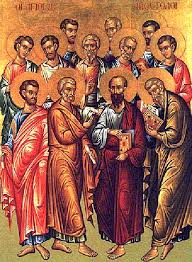
The Twelve Apostles

Twelve is a special number in Biblical thinking. The twelve tribes of Israel, for example [*]. Twelve is also an important number in astrological thinking, twelve months in the year, twelve signs of the zodiac, etc. A number of ancient groups, religions, etc., have special mention of twelve figureheads, and Christianity is no exception.

The problem is that the gospel and other New Testament stories don't really add up. Sure, there are plenty of references to 'The Twelve' in there, but this seems more symbolic, rather than referring to a group of twelve actual people.

So let's have a look at these twelve characters.

Matthew 10v2-4 (and Mark 3v16-19) lists them as: Simon (Peter), Andrew, James, John, Philip, Bartholomew, Thomas, Matthew, James (son of Alpheus), Thaddeus, Simon (the Zealot) and Judas Iscariot.

Luke 6v14-16 has basically the same list, although it is missing Thaddeus and has gained Judas (son of James). Most commentators on the internet and elsewhere seem to assume that these are two names for the same person.

John gives no list of disciples but does have a prominent disciple called Nathanael, who is absent from the other gospels. Lots of people on the internet seem to think he is the same person as Bartholomew, who isn't mentioned in John. Some point out that Bartholomew is really a surname.

So lets have a look at what these characters do in the Bible stories:
  1. Simon (Peter). We know about him, so I'll not detail anything here.
  2. Andrew. Brother of Peter. He is mostly just a name on a list, except in John where he has a few lines of dialogue.
  3. James. James is mentioned in conjunction with John in all the gospel stories. They do things together, they say things together. They have a few lines of shared dialogue. They appear to be members of Jesus's 'inner circle' along with Peter and sometimes Andrew. The only time James is recorded as doing anything without John is when he is put to death in Acts chapter 12. Then, confusingly, he seems to be instantly replaced by another James, the brother of Jesus.
  4. John. See James. John also has a line of dialogue of his own in Luke 9v49 and is sent with Peter to arrange the Passover meal in Luke 22v9. In Acts 3, 4 and 8, Peter and John are together and do everything in tandem; perform a miracle healing, preach, etc. Later in acts there is another John, who is also called Mark.
  5. Philip. Philip is just a name on a list in the synoptics, but has a few significant lines of dialogue in John. A second character called Philip is introduced in Acts 6v5. Philip does a lot in Acts chapter 8, but it has never been clear to me which Philip this is, the disciple or the guy from Acts 6v5?
  6. Bartholomew / Nathanael. Bartholomew is merely a name in a list in three gospels and Acts. He does not feature in John. Nathanael has an elaborate calling story and two lines of dialogue in John 1v43-49. He is also named as going fishing with Peter in chapter 21.
  7. Thomas. Thomas is a significant character in John's gospel, having several important lines of dialogue. But he does not feature at all in any of the other gospels or epistles, except as a name on a list.
  8. Matthew. In the gospel that bears his name, Matthew is a tax collector who is called by Jesus and leaves his job. In the other gospels, Matthew is merely a name in a list, and his occupation is not given.
  9. James (of Alphaeus). This James features only in lists of names and has no other role in the story. Interestingly enough, Mark's character Levi (whose name has been switched to Matthew in Matthew's gospel) is named as being 'son of Alphaeus' as well.
  10. Thaddaeus / Judas (of James). Thaddaeus is only a name in a list, he does not appear to feature beyond this. In John's gospel (14v22) Judas (not Iscariot) has a single line of dialogue, but does not feature otherwise. There are some mentions of a character called Judas (Barsabbas) in Acts, but it is not clear if this is the same character.
  11. Simon (the Zealot). Just a name on a list. There are quite a few other Simons in the stories, as we'll discuss below.
  12. Judas Iscariot. We know about him, so I'll not detail anything here.
So it seems that as far as Mark and Luke are concerned, there are only really three disciples who are characters: Simon Peter, the James-John pair, and Judas Iscariot.

Matthew has specific action concerning the character called Matthew, but for the most part has only the same 'three' disciple characters as Mark and Luke.

It seems that the majority of stories Matt, Mark and Luke present are based on the assumption that Jesus had a retinue of only three disciples. But these writers also believed that Jesus actually had twelve disciples, so they have put in the lists and brief mentions of the other nine to convey this. The other nine really have no role to play. There is no real history about any of those nine in any of the synoptic gospels.

But John attempts to flesh out some of the characters. Andrew, Philip, Nathanael, Judas (not Iscariot) and, particularly, Thomas all feature in his story as characters, although none except Thomas have any discernible character traits.

One thing all this suggests is that none of the synoptic writers were eye-witnesses to any of the events. Someone who was really there would surely have been able to put at least a little flesh on the characters. Beyond that, if we take the traditional view that John's gospel was the last to be written, this pattern suggests that the earliest stories of Jesus really only did feature three (or possibly four) disciples, and the dialogue attributed to the minor disciples in the fourth gospel is there intentionally to beef up the stories such that there appear to be more than just three.

From a quick look at the list of disciples, it seems like whoever created the original list of twelve didn't have much imagination:

Starting with Simon, James-John and Judas, the author gives Simon a brother, so he can be more like James and John; then adds four characters who I guess must have featured in some early Christian traditions - Matthew, Philip, Bartholomew and Thomas. As we see in Acts, there is a Philip 'the Evangelist' who features in the story, could he be included in the list of original disciples on the assumption that he was so important he must have been a disciple? The same possibly goes for Thomas, he was certainly a prominent figure in the early church, the most significant (and possibly earliest) non-canonical gospel is attributed to him. Is his inclusion here again based on a 'must have been' type assumption? I'm guessing Matthew and Bartholomew must also have been significant.

Having added all these, the writer of the original gospel seems to have lost imagination and simply doubled up the big three, creating another Simon, another James and another Judas. These serve only to boost the numbers up to twelve.

Richard Bauckham, in his book 'Jesus and the Eyewitnesses' (which I reviewed last year), goes into great detail about how common certain names were in 1st century Judea. The top male names of the time were:
  1. Simon
  2. Joseph
  3. Lazarus
  4. Judas
  5. John
  6. Jesus
  7. Annanias
  8. Jonathan
  9. Matthew
  10. Manaen
  11. James
Apparently over 40% of men at the time, as far as we can tell, had one of the top 9 names. Its really no surprise then that we should find a Simon, a Judas, a John and a Matthew among a 'random' selection of 12 men. That we should find two instances of one of those names in the selection is quite probable. But finding three doublings in a group as small as 12 is reasonably improbable. This suggests (although does not prove) that some of the names could be fictional.

The names of Jesus' brothers in Matt 13v55 (and Mark 6v3) are James, Joseph, Simon and Judas. Isn't it a whopping coincidence that three of those names correspond exactly with the three main disciples (and the three that were doubled up)? I've even heard it suggested (admittedly by Robert M. Price, who is pretty radical in his beliefs about the editing of the bible) that the 'original' list of Jesus's brothers in the first gospel didn't contain Joseph. Instead of saying:
"Isn’t this the carpenter’s son? Isn’t his mother’s name Mary, and aren’t his brothers James, Joseph, Simon and Judas?" 
the 'original' may have said:
"Isn’t this Joseph the carpenter’s son? Isn’t his mother’s name Mary, and aren’t his brothers James, Simon and Judas?"
If that's the case, then we have an exact correspondence between this list of Jesus's brothers and the three main disciple characters.

Doesn't that strike you as being a bit odd?

Could it be that there were two rival beliefs from the early church which are both condensed in the words of the Gospels? James (with or without John), Simon and Judas were known to have been important figures in the early life of the church, but some believed that they had been brothers of Jesus, while others believed they had been disciples.

In fact, given the stories of Judas that survive, I wonder if John was drafted in as an afterthought to maintain the balance of three disciples or brothers after Judas left the story following his betrayal.

The important thing to notice here is that the stories of Jesus, in their 'original' form, only featured Jesus with three (or four) disciples, but that there was also a belief in a symbolic 'twelve' disciples which appears to have been overlaid on the 'originals'. This observation itself suggests either (a) that the gospels must have all been written a significant time after the events which they describe, such that nobody really remembered the details of any of the stories accurately, or (b) that there were rival (and incompatible) streams of stories about how many disciples Jesus had and the author of the original gospel tried to harmonise these when he wrote the story down. This second option, of course, throws a big question mark over the 'real' historical Jesus. If he had twelve disciples then the source of most of the stories was basically wrong in his important facts. However, if he only had three disciples, then it is clear that most of the stories have been changed before they got to the form in which we have them. Of course, there is also the possibility that none of these stories go back to a historical character.

Sigh. As ever, I find that the harder you scrutinise an issue in the bible, the larger the holes become. This one is pretty much all hole.


Footnote:
[*] The twelve tribes: Reuben, Simeon, Levi, Judah, Issachar, Zebulun, Benjamin, Dan, Naphtali, Gad, Asher, Ephraim and Manasseh. Erm, that's thirteen tribes, not twelve. Sure, Ephraim and Manasseh are supposed to both be descended from Joseph, but they are never collectively referred to as 'The Tribe of Joseph'.