Thursday, October 11, 2012

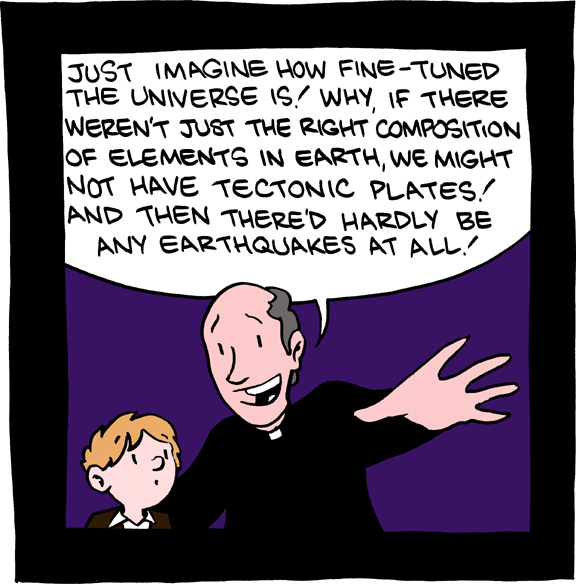
The fine tuning argument revisited

I just listened to last week's Unbelievable podcast on the subject of 'Atheism's New Clothes', featuring a discussion between (academic scientist and Christian) David Glass and (academic philosopher and atheist) James Croft. The discussion was loosely based around the issues raised by Glass in his recent book 'Atheism's new clothes' (sadly not on Kindle yet) which is a response to the books and arguments of the 'new atheists' such as Dawkins, Harris, Hitchens and others (Dennett is usually mentioned in that list, but I don't think he was mentioned in the programme, so I don't know if he is addressed in the book either).

The discussion was supposed to cover all the issues raised in the book, but got bogged down on the issue of the 'fine tuning' of the universe. While Croft did a remarkably good job of shooting down Glass's fine tuning argument and discrediting his flawed use of probabilistic reasoning, he never managed to convince Glass that his take on the fine tuning argument was anything less than water-tight.

The fine tuning argument is summarised in this way on Wikipedia:
"The fine-tuned Universe is the proposition that the conditions that allow life in the Universe can only occur when certain universal fundamental physical constants lie within a very narrow range, so that if any of several fundamental constants were only slightly different, the Universe would be unlikely to be conducive to the establishment and development of matter, astronomical structures, elemental diversity, or life as it is presently understood. The existence and extent of fine-tuning in the Universe is a matter of dispute in the scientific community."
The point is that certain universal constants are built-in to the universe, and without these constants the universe could not sustain life (or, at least, life as we know it), yet there is (so it is claimed) no scientific explanation for why the constants should have those values, and not other values, which would have resulted in a universe incapable of producing life.

The main theistic argument here goes like this: the probability that the constants could have just happened upon the 'correct' values 'by chance' is so vanishingly small that it didn't happen. Those constants must have been selected by an intelligent designer, so therefore there must be a God.

Atheistic counter arguments usually go two ways:

The first is to propose a multiverse type arrangement where there are an infinite number of possible universes, each with a different set of universal constants. These universes may either be in series in infinite time, or in parallel in infinite dimensions. Given enough coordinates in probability space, then it becomes highly likely that somewhere in all this probability there will be a universe with the 'correct' set of universal constants. This way of thinking is favoured by a great many scientists. Of course, this raises the issue of the unseen infinite which I have blogged about before - you can demonstrate that anything can be achieved if you can invoke the explanatory power of an unseen but infinite factor.

The other way is to show that the issue is being looked at the wrong way around. It is not that the universe was fine tuned for our kind of life to emerge, but rather that our kind of life is a product of the kind of universe in which we are. Universes with different sets of constants, should any exist, would produce different emergent types of life, but in every instance it would appear (to the emergent life) that the universe was fine tuned for them to exist.

The show set me considering whether the theist actually has a valid argument. I actually found myself wondering this way:

Suppose the universe was created by a supernatural being who preset the fundamental constants, how did that being decide what the constants should be? Did he (lets stick to convention here and refer to the deity as masculine) try out any other sets of constants in other universes only to discover that they didn't work? How many times did he do this? Even if he only did a 'thought experiment', this is still working through all the possible alternatives until a solution is found. Following this line of reasoning you very quickly end up with the multiverse type arrangement (again with the inherent unseen infinite problem) and God is reduced to the mere mechanism by which the various universes choose their parameters.

Of course, no theist really thinks like this. It is obvious to them that God would just know what the 'correct' parameters should be. But why? For the theist it is not that God had to work out the right parameters, he just knows them. I suppose you could say that the correct parameters for the universe are just there in the mind of God. But how is this thinking any different from the non-theist explanation which thinks that the correct parameters are just built in to the universe and couldn't be otherwise?

In order to demonstrate that the parameters are 'fine tuned' you actually need to be able to demonstrate that the parameters could have been otherwise. As far as I know, no theist has ever done this. As far as we can tell, those parameters are necessary features of our universe and not variables.

Fundamentally, the fine tuning argument for God does not and cannot explain how God came up with the set of fundamental constants that appear to be built into our universe. In other words, it has no explanatory power.

It boils down, basically, to these two options:

  1. The universe has a set of physical constants built into it at the outset. We do not know how these constants were fixed. Or
  2. The universe has a set of physical constants built into it at the outset. They were put there by God. We do not know how these constants were fixed in the mind of God. We do not know how God came to be there.
It looks to me that God doesn't really play a part in the argument. He actually complicates the origin model rather than simplifying it. With God in the picture there are more questions and more unknowns.

Should we use Occam's razor here?

Tuesday, October 09, 2012

Science vs. Religion

I seem to have read and listened to a number of things in the 'Science vs. Religion' debate recently. Are they compatible? Are they complimentary? Are they 'non-overlapping magisteria'?

Reflecting on these questions I have come to the following conclusions:
  • Science and religion must be compatible if and only if we live in a universe with a supernatural component, that is, if there is a God.
  • Science and religion must be incompatible if and only if we live in a universe with no supernatural components, that is, if there is no God.
So, fundamentally, believers in any religion can come around to believing that religion and science are compatible and complimentary - because their world view requires this. However, materialistic 'hard line' atheists will, if they think logically, come to the conclusion that religion and science are incompatible - their worldview requires this.

The answer to the question is therefore: it depends who you are and what you believe.

This is not very useful. To me it looks like we're asking the wrong question here. The question is not are science and religion compatible, the essential question is this: Is there a God? If you can answer that question, then the other question is solved along with it.

Thursday, October 04, 2012

Debate rules...

What the hell is going on?


Fair point, well made.

Wednesday, September 12, 2012

Well eductated atheists?

I just read this quote on this blog:
"Well-educated Christians deconvert to atheism, but well-educated atheists don’t convert to Christianity. More education about the history and origins of Christianity increases the likelihood that the Christian will deconvert, but more education increases the likelihood that the atheist will stay put. Education pushes you in one direction only."
Hmmm. What do you lot think of that?

The other Holy Trinity...

It is a caricature, but those outside of the tradition in which I was raised occasionally accused it of believing in the other Holy Trinity: The Father, the Son and the Holy Bible...

Regular readers of this blog will have noticed that much of my doubting over the last couple of years has been on issues connected to the third 'person' of that trinity, the Bible itself.

Through quite a lot of reading, listening and reflecting, I have come to the conclusion that the Bible is not a book authored by God, but rather is a very human document which shows the beliefs of various people and groups of people at various points in history, even though many of these are in conflict with other beliefs expressed in the same collection, and even sometimes in conflict with other beliefs in the same book.

This discovery has more or less knocked out one of the legs of the three legged stool upon which my entire belief system sat. It is fair to say that most of what I formerly believed has come crashing to the ground.

If I had been raised a Catholic, this wouldn't necessarily have been a problem. Remove the authority of the Bible from a Catholic belief system and the entire thing is still upheld by the authority of Church Tradition. But as a good Protestant, I can't accept that. Sola Scriptura! And thus, as a good Protestant, I can't remain a good Protestant...

What I'm left wondering, even at this stage, is if it is possible to rebuild my belief on a different set of legs. I don't want to reject everything just because some things need to be rejected. Babies and bathwater. But I'm not sure if what remains without the authority of the bible is anything big enough upon which to build.


Saturday, September 01, 2012

Unbelievable Miracles

The Radio show 'Unbelievable?' had two shows looking at miracles earlier in the year - the first show looked at miracles in the bible and the second one looked at miracles today. OK, I'm a bit late in commenting.

The guests on the show were:
  • Craig Keener, a theologian who has just written a huge book on miracles and miracle claims, which concludes that miracles happen today and therefore it is legitimate to believe the biblical miracle accounts. And
  • Geoff Lillis, an atheist who is a regular contributor to the Unbelievable forum, Facebook page, etc. I must say, he presented himself and his case very well.
Keener did a good job of demonstrating, with examples, that miracle claims are made within a Christian context all over the world today. And that many of these miracle claims are made by reliable witnesses. And that, in some instances, the miracle claims can be supported by medical evidence.

Lillis did a reasonably good job of questioning the evidence and suggesting non-miraculous explanations for some of the alleged miracles.

What I found frustrating, listening to the show, was that all of the contemporary miracle claims which were discussed involved medical healings or resuscitations from apparent death-states. I don't mean to dismiss these as irrelevant, and I'll get back to these below, but what about other kinds of miracles? Biblical miracles include the multiplication of food (feeding of 5000, etc.), turning water into wine, walking on water, cursing fig trees, and so on. No contemporary claims of anything like these were discussed - does nobody claim anything miraculous like this anymore?

Faith healers do what it says on the tin - apparently heal people using 'faith'. There's no point in denying this, it happens all over the world, to many people, in many different faith contexts. And I suppose that is the point. Christian faith healers certainly seem to be able to heal some medical complaints. But Hindu faith healers also do. And so do some African 'Witchdoctors', and so on.

Is there any evidence that proportionately more faith healings are successful in Christian faith contexts than in those of other religions? If the healing was due to the actions of the one, true God, who is only found in Christianity, then you would expect that you would only find healings in Christian contexts, and not in others. The fact (and I'll admit I haven't done much research on this matter beyond a quick Google search) that faith healings occur in all faith contexts actually serves to underline the non-special nature of Christian faith healing. Or, to put it more bluntly, to emphasise the fact that the apparent healing does not come from any particular God, but rather from 'faith' itself.

Believing that there is a God who can and will heal you is, in many cases, the source of enough hope, or whatever, to effect healing. Which is why claims of faith healing are generally limited to non-visible ailments, from back pain through to cancer. Faith healers cannot make limbs grow back, although, there still is the issue of the leg-lengthening thing, maybe that has more to do with muscle relaxation than bone growth, I don't know.

But what about the non-medical miracles? Has anyone multiplied food miraculously in recent years? Turned water into something alcoholic? Walked on water? Parted seas or rivers? Miraculous catches of fish? People carried up to heaven in fiery chariots? This is a serious question, I want to know if anyone claims these things today. Because if not, then why should we even entertain the notion that any of the biblical miracle claims are anything other than myths?


Wednesday, August 22, 2012

What are you left with?

I just listened to Bart Ehrman's recent appearance on the Unbelievable radio show, with Justin Brierley. Unlike most Unbelievable shows, this was not a debate between two people with opposite opinions, but was rather a Q&A session with Bart, on the subject of his recent book "Did Jesus Exist?"

For those of you who don't know, the book defends the existence of a 'historical' Jesus and is a response to the 'mythicist' position that is increasingly popular on the internet, that the biblical Jesus is a mythical character and is not based on the life of a real person. Authors like Robert M. Price, Acharya S. and, particularly, Richard Carrier have got particularly worked up by some of the things Ehrman said in his books about them and their beliefs, and the debate has got angry and ugly at times. But Unbelievable broke its usual format and didn't have a debate with any of them, perhaps because Bart wasn't prepared to debate on this issue.

The show contained a lot of discussion around the subject of the existence of Jesus, without actually saying anything about the life, character, actions or sayings of the Jesus who apparently did exist. I felt a bit disappointed in this.

Ehrman stated quite categorically that he believes in a historical Jesus, but that there was no resurrection. So what Jesus does he believe in? Not Jesus Christ - Christ being another word for Anointed or Messiah - but merely Jesus, some guy from Nazareth.

I've discussed this before, but come up with no good answer. What happens when you remove the central claim of the Gospel accounts, that Jesus was resurrected and hence validated as Son of God? What are you left with? Miracle stories? Well, I guess if he was just a man you have to remove them from history too. So you end up writing off half the content of the gospels as non-historical, but the important point to note here is that the reasons for doing this have nothing whatsoever to do with a study of the gospel accounts themselves. Nothing in the gospels suggests that one verse is historical and another is non-historical. The distinction is largely arbitrary based on the (non-supernatural) world view of the interpreter. Everything supernatural is written off, everything else might be historical. Is this a good method? Doesn't sound like it to me.

Then you start applying various criteria to the text: the criterion of embarrassment, the criterion of dissimilarity, the criterion of multiple attestation, etc. but I don't think these are actually very good grounds for testing anything. For a start, the criteria pre-suppose that some material is authentic to Jesus and some is inauthentic. But if all of it is inauthentic we will still end up selecting some of it as more likely than other bits, so there is a selection bias. Then again, the opposite works too, if all of it is authentic, the criteria will still lead us to write off some of it. Not very good criteria.

What it all boils down to is this. Whichever set of rules or criteria you use to investigate the text will have an influence over what you decide to be authentic. Someone who prefers one set of criteria will get a different picture of Jesus than someone who prefers a different set of criteria.

So what are you left with?

A man who might or might not have been called Jesus, who might have been born in Nazareth or might have been born in Bethlehem, who might or might not have been baptised by John (probably was), who said some things (though we can't be sure what) and annoyed the Romans such that they killed him (although we can't be sure why).

That's not much to defend in a book is it?

Sunday, July 29, 2012

Why trust the Bible?

There is a book by Amy Orr-Ewing with the above title, which I had on my wishlist for a while but have never got around to reading. This is not a review of that book. But it is a serious attempt to answer the same question.

Ms Orr-Ewing addresses some of the issues raised by bible skeptics and sets out to show that the bible has not been distorted through many generations of manuscripts, is historically reliable, is demonstrably more reliable than the holy books of other religions, and furthermore she defends the bible's stance on sex and gives context for the overt violence and explicit sexism in there.

I've read defences of all that before. I'm sure Ms Orr-Ewing does a good job of presenting the same old arguments in a modern and readable manner. But as I say, I haven't read the book...

So. Why trust the Bible?

I suppose we really need to unpack the "trust the bible" part of that before we can get to the "why".

Here is what Scripture Union says about the bible in its statement of faith:
"We believe that the Old and New Testament Scriptures are God-breathed, since their writers spoke from God as they were moved by the Holy Spirit; hence are fully trustworthy in all that they affirm; and are our highest authority for faith and life."
UCCF has a slightly different emphasis:
"The Bible, as originally given, is the inspired and infallible Word of God. It is the supreme authority in all matters of belief and behaviour."
The church I currently attend has this:
"We believe that the Holy Spirit inspired the human authors of Holy Scripture so that the Bible is without error in the original manuscripts. We receive the sixty-six books of the Old and New Testaments as our final, absolute authority, the only infallible rule of faith and practice. "
These statements affirm that the content of the bible is what was imparted from God to men and is therefore trustworthy, without error, infallible and has supreme authority. These statements then all include some wooly wording which seems to be a 'get out of jail free' card - "as originally given" or "in the original manuscripts" - the only point to these clauses is to imply that the bible we now have might (just might) contain a little error or two. I happen to like the SU version that doesn't use that cop-out, but does restrict the remit of the bible to merely "all that they affirm" and limits the scope to only "faith and life", not science or history or anything like that.

This avoids the problems of the historical accuracy of the bible. Basically while much of it might be historically accurate, there are a few things we can point to in there that we know are historical errors. The classic example of this is when the census in Luke took place - was it when Quirinius was governor of Syria or was it during the reign of Augustus? It can't have been both as the two did not overlap.

That's not to say that the bible does not contain history, its just that some of the history it contains is wrong. So can you trust the bible for historical details? Sometimes yes, sometimes no.

The problem with this is, of course, that it is clear that if there was an impartation of the bible from God to man, then this was not an infallible process, and errors definitely have got in. The bible is not infallible, at least not in the details.

OK, so maybe the bible isn't infallible, but maybe it is trustworthy as it was written by trustworthy men and women (there is a case to be made that Hebrews might have been written by a woman, but I'm not going into that here)? So who were these people? Well, many of them are unnamed, so we don't really know how trustworthy (or otherwise) they were. But some are named. Peter, Paul, James and Jude are all self-identified in their epistles. Well, that could be the case in some instances, but Peter is interesting. Textual study of 1st and 2nd Peter has shown conclusively that these letters could not have been written by the same person. Maybe one of them was written by Peter, but the other certainly was not. Yet both claim to be by Peter. The only reasonable conclusion to make of this is that (at least) one of them is a fake. And thus, there are fake books in the bible, bearing false witness to who it was who wrote them. Textual study also suggests that the author of the 'pastoral' epistles was not the same guy as wrote the likes of Corinthians or Romans, so some of the letters attributed to Paul, and bearing his name are fakes.

So far, we have the bible containing demonstrable errors and demonstrable lies.

Why trust this book? It seems we can't trust the details or its claims about who wrote some bits of it.

But good advice and spiritual truth can be conveyed by anonymous authors, can't they? Can we trust what the bible says about God and how God wants us to live? Surely the 'red letters' (sayings directly claimed to be the words of Jesus or the words of God in the Old Testament) can be considered trustworthy?

Well, leaving aside the observation (that I made in a recent post) that Matthew and Luke, in copying Mark's gospel actually changed some of the words attributed to Jesus, and leaving aside the observation that the way Jesus speaks in the fourth gospel is completely unlike the way he speaks in the other three, we see that even the words directly attributed to God himself in the Old Testament are not trustworthy. Look at Ezekiel 26v7-14:
7 For thus says the Lord God, “Behold, I will bring upon Tyre from the north Nebuchadnezzar king of Babylon, king of kings, with horses, chariots, cavalry and a great army. 8 He will slay your daughters on the mainland with the sword; and he will make siege walls against you, cast up a ramp against you and raise up a large shield against you. 9 The blow of his battering rams he will direct against your walls, and with his axes he will break down your towers. 10 Because of the multitude of his horses, the dust raised by them will cover you; your walls will shake at the noise of cavalry and wagons and chariots when he enters your gates as men enter a city that is breached. 11 With the hoofs of his horses he will trample all your streets. He will slay your people with the sword; and your strong pillars will come down to the ground. 12 Also they will make a spoil of your riches and a prey of your merchandise, break down your walls and destroy your pleasant houses, and throw your stones and your timbers and your debris into the water. 13 So I will silence the sound of your songs, and the sound of your harps will be heard no more. 14 I will make you a bare rock; you will be a place for the spreading of nets. You will be built no more, for I the Lord have spoken,” declares the Lord God. 
This is a very detailed and precise prediction of the destruction of Tyre. The thing is, it never happened. Yes, Neb and his army came from the North, yes, they besieged the city. No, they didn't breach the city, no, they didn't trample it, no, it was not destroyed. The prophesied event did not happen. Its not as if the prophecy wasn't right in the details, it wasn't right at all. It was wrong. It says "I the Lord have spoken..." yet clearly either he hadn't spoken, or the prophet completely misunderstood what God had said. Either way, the bible contains failed prophecy and misrepresents the very words of God.

So, is the bible trustworthy?

Doesn't really look like it does it?

Yet millions of people read it on a regular basis and take guidance from it. They claim God speaks to them through it. They believe it to be trustworthy and many will say that their experience shows it to be trustworthy. Bestselling books call these people 'deluded'. Are they?

If there really is a God, would he speak through a book that contains lies, misinformation and false claims about the things he allegedly said? Well, he might. But he could just as easily speak through other flawed and misleading writings, like the holy books of other religions or even the horoscopes in the morning papers.

None of what I say above leads us to the conclusion that God, assuming there is a God, can't speak to us, assuming he wants to speak to us, through the bible. Its just that the bible, on the basis of the above, doesn't seem to be a special way to find his words. It is not special revelation. If God wants to speak to you, rest assured he will, irrespective of what you read. But I don't think I can trust the bible as the exclusive way to hear from God anymore.

Thursday, July 26, 2012

Conversion, deconversion and the will to believe

I just listened to a show on Unbelievable with a discussion between Leah Libresco, a former outspoken atheist who recently converted to Catholicism (you can read about that on her blog), and Hemant Mehta, the 'friendly atheist' who once 'sold his soul on eBay' (you can read about that on his blog and book). The conversation was mostly about Leah's conversion and the reasons for it. She was quite unable to give a compelling case to him about why she converted.

Listening to the conversation reminded me of a few thoughts I'd been meaning to work up into a blog post for some time, so here goes.

The main thing that struck me during the show was how the 'friendly atheist' simply could not understand how an intelligent atheist could change her worldview and become a believer in a specific religion. He basically said he could understand it if she had become a deist, but couldn't understand how she could possibly have decided that Catholicism was the way to go.

But why is this surprising? People change their worldviews all the time (that is, I mean, all the time there will be someone changing their world view, not that any individual is constantly changing their views). Christians become atheists, muslims become Christians, hindus become muslims, atheists become Christians, secularists become muslims, agnostics become believers, believers become agnostics, and so on, and so on. Worldview conversions happen all the time and, as far as I can tell, the people involved go from being a real believer in worldview A, to a real believer in worldview B, its not as if they were pretending in the first instance. People who genuinely believe that there is no God can and do come to believe that there is a God. People who genuinely believe that there is a God and they are in a 'personal relationship' with him can and do lose that faith and come to believe that there is no God. It happens. Whatever our worldview, we should not be surprised to find that people who once agreed with us can change their minds and end up disagreeing with us, or vice versa.

Whatever your worldview, be it Christian, atheist, or whatever, the evidence is that some people who share your views will end up rejecting them. It happens. And it doesn't matter which worldview someone starts out from, some people will always reject their former worldview in favour of a different one.

What I take away from this is the conclusion that no worldview is 100% compelling. There are good arguments in favour of most worldviews, there are good arguments against most worldviews. There is no set of evidence for any worldview which is guaranteed to convince any believer in a different worldview to change tracks. None. 

A Christian cannot convince an atheist to convert purely on the basis of evidence or reason. 

An atheist cannot convince a Christian to deconvert purely on the basis of evidence or reason.

One thing is missing. The will to believe.

If you have the will to believe in a certain worldview, you will find the evidence in favour of it more compelling than the evidence against it. But you can't be reasoned into a change in the will to believe. The will to believe, I think, has to come from within and is probably much more to do with relationships and emotions than it ever has to do with reasoning, evidence or reality.

Chances are, if you mix with a group of people with a different worldview from your own, and you find out that they are nice, intelligent and decent people, you will be far more likely to develop the will to believe in their worldview. Relationship and emotion will slowly shift the balance of will, and you might end up agreeing with things that you once found disagreeable or find some arguments compelling which you once found unbelievable.

I know this has happened in my life. Reading between the lines in what Leah Libresco said in the radio show I can see it in her life too. She mixed with catholics, had a catholic boyfriend, found them to be nice and intelligent people, and slowly came around to their way of thinking.

There are some statistics I heard once [citation needed] which show that most people who change worldview beliefs change them at times of stress or change of circumstances in their lives. Death of a family member, birth of a child, relocation to a new town or country, leaving home for the first time, etc. These are the times when people change worldviews. This is why missional organisations tend to target students - generally away from home, in a new place, under stressful circumstances. Students are far more likely to change their beliefs than people who have been in the same location and job for many years. Looking back over my life I can see this in action - I became a Christian in my first term at university, my first time living away from home. And I began to question the assumptions of my Christian faith following the death of my father. So my experience mirrors these statistics. In other words, emotional change led me to change the emphasis in my will to believe.

What about the 'conversion experience'? I had one of these back in 1988 when I became a Christian. Was that real? If I'm considering letting go of Christianity, how can I deny the reality of the experience?

I can't. It was a real experience. But maybe my interpretation of that experience was all wrong. For several years (yes, years) before I became a Christian there had been tension in my will to believe. Or rather, there were two competing wills to believe in my life, basically one pulling me in a Christian direction, and one pulling me in the other (OK, I don't believe there are only two ways to live, but it seemed like it at the time). When I (finally) decided to become a Christian, the tension was resolved and there was release.

Ask a blues musician about tension and release. The release only works if it follows the tension. The emotional release in conversion only manifests because it follows an emotional tension. The experience is real, but it stems from emotional release, not necessarily the presence of God.

I'm aware that in my life at the moment I have tension in my will to believe once more. I genuinely do want there to be a God and for the major claims of Christianity to be true - I have the will to believe in that. But I also have a strong will to believe the truth and am finding out that Christianity looks less and less true the harder you scrutinise it. Once again, I have two competing wills to believe, and I am sure that whenever I abandon one and wholeheartedly embrace the other, there will be release. It wouldn't surprise me if I have a reconversion experience or a deconversion experience, depending on which way I go.

In closing it looks to me that, most of the time, those of us who change our worldviews do so for emotional changes in our wills to believe. Despite what we think, we don't do it out of rational choice. I once could see really compelling reasons to be a Christian, I now see really compelling reasons not to be one. The evidence hasn't changed, but my will to believe has shifted. The thing is, if it really does boil down to this, then actually that seems pretty good evidence that there is no God behind belief. If the worldview we pick is dependent on our circumstances and external influences, and changes in those can result in changes in our core beliefs, even though the evidence doesn't change, then this suggests to me that the evidence for any particular God is simply not compelling, and there is no good reason to believe any of them, except for the emotional need to connect to like-minded people.

So be careful who you mix with, you will quite probably end up believing the same as them.